Writing a Homeschool Music Curriculum
After a year and a half spent creating my first homeschool music curriculum, I’m returning to this littler corner of the internet to share the story behind Living with the Muses and the deeply personal letter that opens its pages.
Hello—long time readers! It has been a while since I have written here on my blog. We have a new name—Musings, and I couldn’t be more excited to start writing here again. The better part of a year and a half has been spent writing my first homeschool music curriculum, and now that I am on the other side and have a finished curriculum in my hands, I find myself constantly flipping through the pages in amazement. I don’t say this to boast, because truly, a huge part of this feels so surreal. I look incredulously at the finished book, and I have to say, I am so proud I could burst. Even if only a few families ever purchase and I don't retire on a Greek isle from sales ;) I can honestly say that I would do it over again, because the feeling I feel, and the excitement at the connections I made throughout writing this curriculum are worth every ounce of sleep I gave up writing into the night and early morning.
It started out as me scribbling ideas and thoughts in my little notebook beside homeschool lessons plans and endless to-do lists that never get done. I had been giving a lot of thought about how I wanted to teach my eldest the subject of music in a more formal way, now that he was in first grade. It was so exciting to see him grasp deeper concepts over the past year, and become truly interested in learning. I thought it was now time to start teaching music theory, as he had been learning music strictly through an aural and kinesthetic approach up to that point. I had not yet started teaching him to read music—and that was on purpose. As I started digging deeper into how I wanted him to learn—which was totally different than how I had learned—I kept coming back to how music is really integrated with everything else. I’ve always loved reading about Ancient Greece and its ideas about education. I slowly started ruminating on all of this, and I was begin to see that everything I loved about different educational philosophies could usually be traced back to Ancient Greece and its ideas.
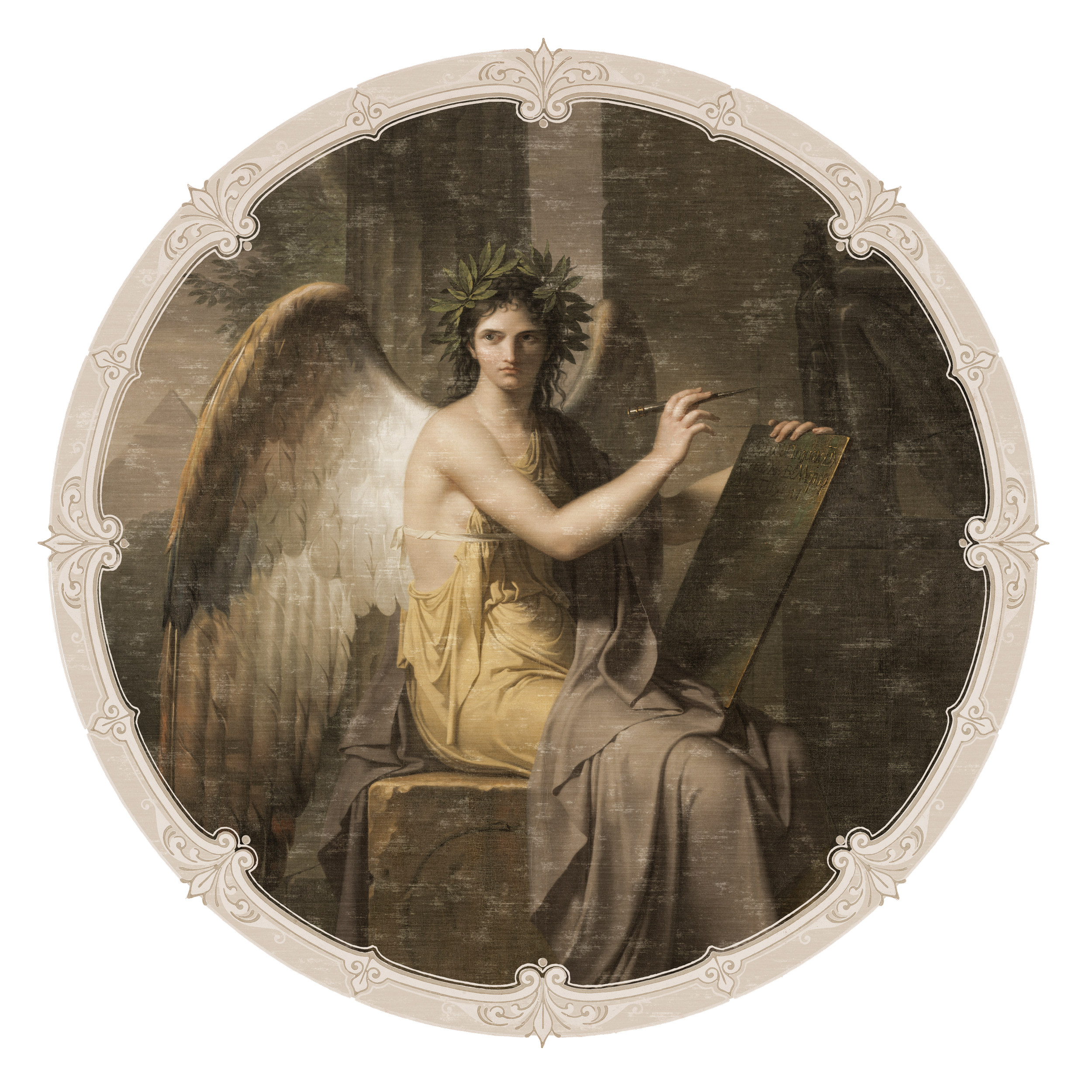
“He who has a taste for every sort of knowledge, and who is curious to learn and is never satisfied, may be justly termed a philosopher.”
—Plato, The Republic
I also luckily chose a Godfather for my youngest son who reads and speaks fluent Ancient Greek, Latin and many other languages. He is one of the most intelligent, humble and kind people I know, and I feel that I could pick his brain endlessly. He has given me so much food for thought over the years, and I am always in awe of his genuine love of knowledge and learning. He is exactly the kind of person I hope my children will emulate and who I aspire to be like, though I fear I would need to live a thousand years to get even remotely in the same sphere as him. You will see him carry a new (often old) book to Mass every Sunday—Socrates (in Greek!), poems by T.S. Eliot, you name it. He probably does not know this, but he inspired this curriculum in many ways. His love of learning, reading all forms of literature, art, music and making connections across subjects has inspired me beyond measure. So this curriculum is, in many ways, my attempt to pass on what he embodies: a genuine love of learning and the beautiful fruit of a true liberal arts education.
With that said, I thought I would share the opening letter from my new homeschool music curriculum, Living with the Muses. I wrote the letter when I was in the throes of learning new Adobe software, with my sweet little baby in her carrier on my chest and so many emotions coursing through me. I struggled to find the words to express everything this curriculum is to me and everything I hope it will be to many families. It’s so incredibly personal to me, and with every email, comment and message that comes my way celebrating my vision, I do a happy dance wherever I am and blink eyes rapidly that seem to well up without regard to where I may be at the time.
Without further ado, my letter to the families who purchased Living with the Muses, Volume I.
Dear Families,
I never dreamed I would one day publish my own music curriculum and it certainly was not something I imagined I would be able to accomplish in this season of motherhood. Between mothering a new baby and three sons, homeschooling, my business and juggling social media, I think I have a strong dash of delusion to thank for taking this on. Of course it goes without saying, none of this would be possible without my unicorn of a husband who took over doing dinner and dishes for months on end.
If the past eight years have taught me anything, it is that motherhood has a way of changing us for the better. It stretches us creatively, emboldens us and strengthens us if we allow it. Things you never thought possible become not only possible, but necessary, because they are for your children. So here I am with a two month old baby snoozing on my chest and imaginary battles being played out at the highest decibel levels in the living room as I type away, hoping beyond measure that what I have created is beautiful and inspired.
The idea for Magical Music Method was born when I was pregnant with my first child. I wanted my children to know music the same way they learned to speak, naturally, joyfully and as an ordinary part of everyday family life. I wanted music to be something they lived with and that would cultivate their own love of beauty. As my children grew, so did that vision. When my eldest reached grade school I found myself asking, ‘What comes next?’
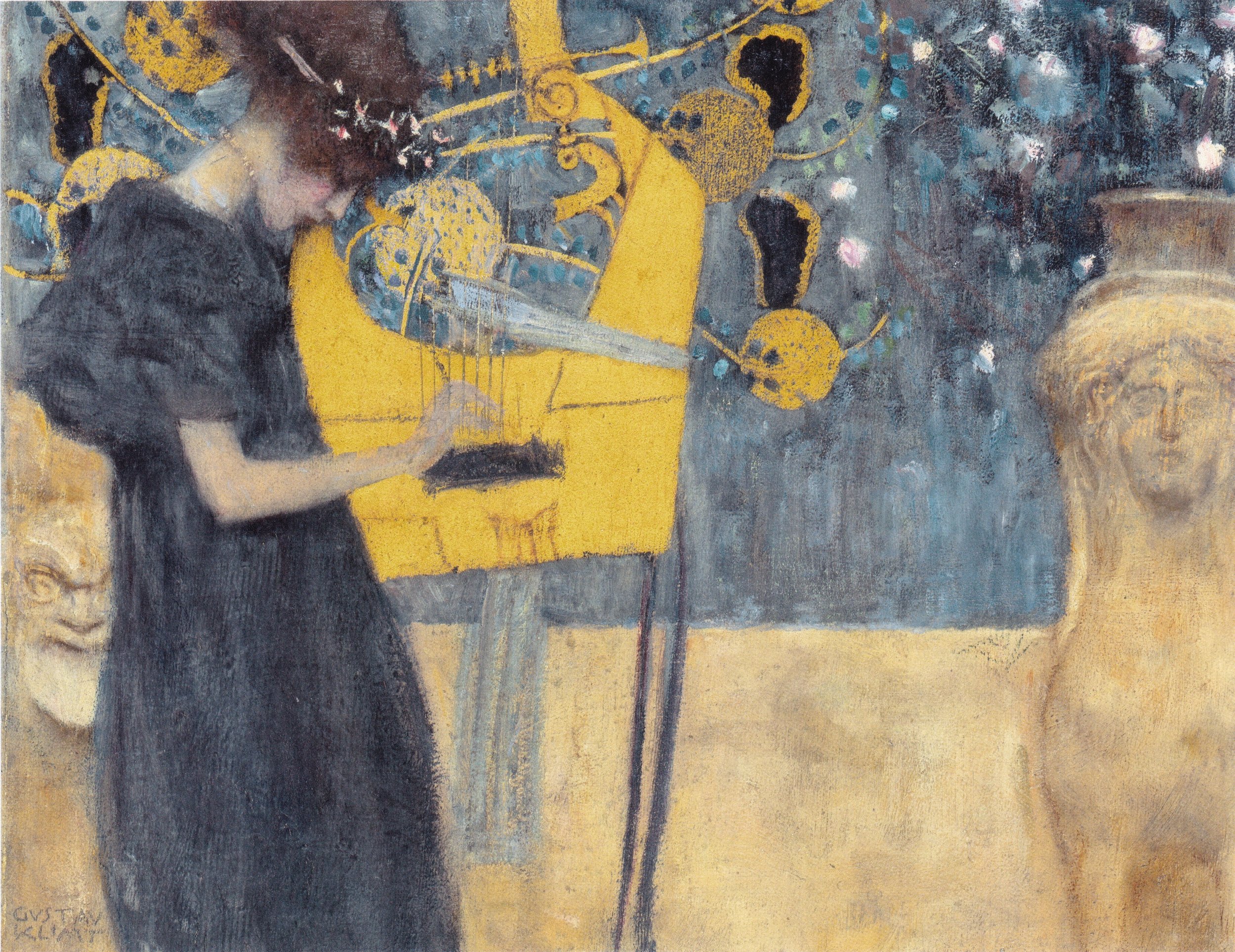
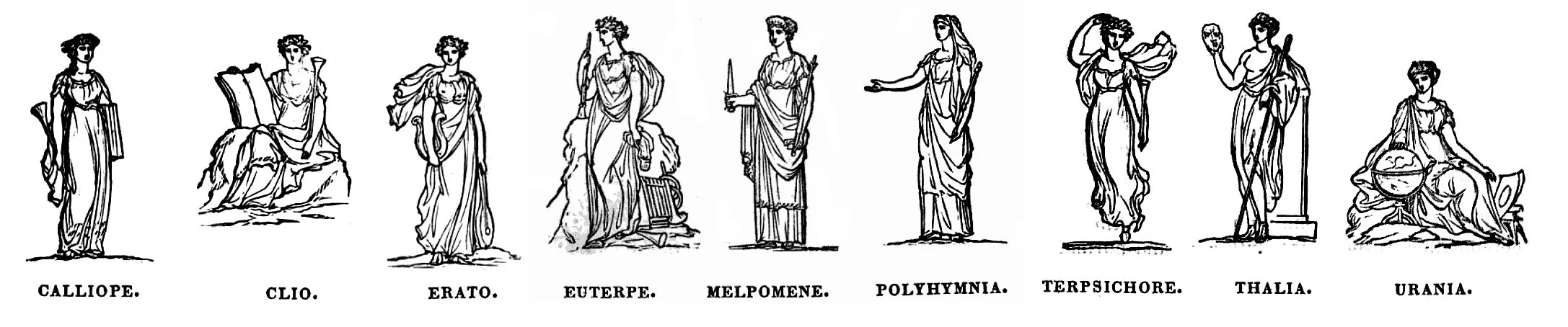
This curriculum is my answer. As I was writing over the course of the past year, I had written down An Integrated Music Curriculum as the working title of this project. It sounded boring, but I thought it was pretty accurate. I’m not teaching ‘Music Appreciation’, or just ‘Music History’, nor am I just teaching ‘Music Theory’, rather I am teaching music through the entire lens of the arts. Like the ancient Greeks! The Greeks believed in the nine muses, each intrinsically linked to music. It would be unimaginable in ancient Greece to learn music without learning poetry, and learn history without song, and to study astronomy without acknowledging the mathematical harmony of the universe. That was when it hit me – Living with the Muses. As soon as I thought of it, I knew that was it. I had nailed my entire music philosophy in one title. Afterall, the word music comes directly from the ancient Greek word, mousikē, meaning, art of the Muses. At the risk of sounding like the Dad from “My Big Fat Greek Wedding,” I’ll digress, but I think you may start to see the underpinning philosophy behind Living with the Muses.
This first volume is part of a three-volume course of study for Grades 1—6, that is meant to be lived with and revisited over and over again. Here your family will learn music, art, poetry and song together. Thank you for welcoming my curriculum into your home. I am deeply grateful that you entrusted me to share with you–mousikē.
With gratitude,
Veronica
If you made it to the end of this, thank you so much for being here. Every share, comment and purchase helps me continue the crazy endeavor of creating content that often feels like throwing a teaspoon of water into the expanse of the sea.
GIVEAWAY CLOSED. Winner selected below. As a token of my gratitude, please leave a comment with your own musing and include, if you like, “I would love a hardcopy of the homeschool music curriculum." I will choose one reader at random on September 10, 2026 @10:00PM EST and send them a hard copy of my curriculum.
Teaching Kids About Time 🕰 Through Music + Art 🎶
If you want a child to remember something,
put it to song. Music
makes everything “stick.”
I have been teaching my eldest about the clock and I wanted to share this fun musical lesson I created that incorporates music and art.
Understanding the Concept of a “Second.”
The concept of time (seconds, minutes and hours) is a very abstract idea to most children. They naturally do not keep track of time like adults, and live in the moment. When teaching about how to tell the time, it is enormously helpful to bring the idea of “time” into the body and give it a concrete meaning that makes sense to a child.
This is where music and movement can shine! Music is time and children often understand music organically and can feel the pulse of music.
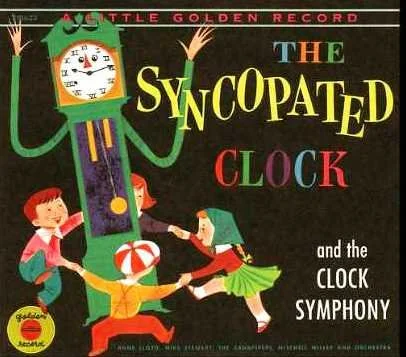
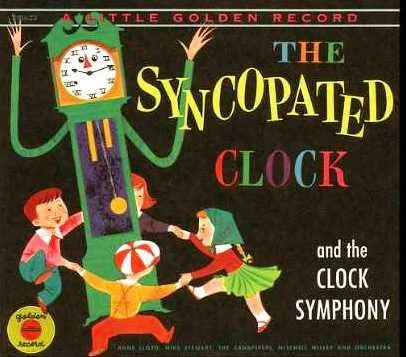
Leroy Anderson’s “The Syncopated Clock,” is a wonderful piece to establish this sense of time, because the beat is literally heard with a clock ticking sound and because it’s all about a clock and children will remember this very distinct melody. Now a little warning for the non-musicians. There is some moments in the music where the “ticking sound” stops, but it is actually a golden moment of learning for the child. You can take the opportunity to teach them that the beat (ticking) keeps going even though they didn’t hear it. This will build their musicianship skills at the same time.
Leroy Anderson’s “The Syncopated Clock.”
In This Lesson:
We will use a traditional Waldorf Math verse and sing it to the melody of “The Syncopated Clock,” to teach the concepts of what constitutes a minute and an hour and how time is made up of seconds.
We will keep a beat (the ticking) to represent the second, and use large circle movement to bring learning into the body.
We will create a movable clock out of watercolor paper to make a useful learning tool that the child will be immensely proud of and will be useful for many months to come.
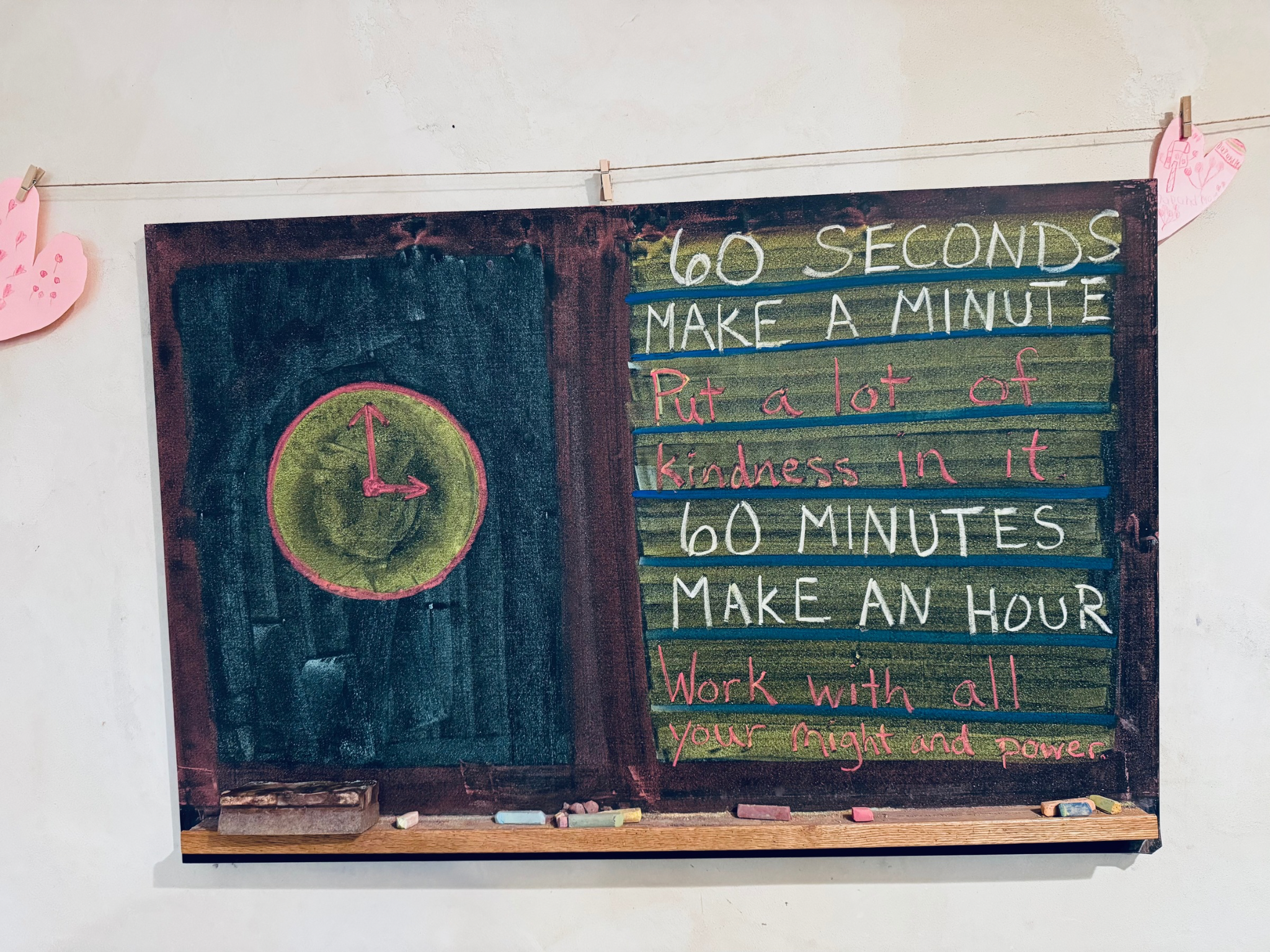
Waldorf Math Verse
By Dorothy Harrer
“60 seconds makes a minute,
Put a lot of kindness in it.
60 minutes makes an hour,
Work with all your might and power.
12 bright hours make a day,
Time enough for work and play.
12 dark hours through the night,
Give us sleep till morning light.”
Singing the Verse to the melody of “The Syncopated Clock.”
(Please excuse my 🤧 congested singing voice, as I am still recovering from a head cold. And please subscribe to my channel to help me make it to 1,000 where I can monetize. 🙏 )
Large Circle Movement
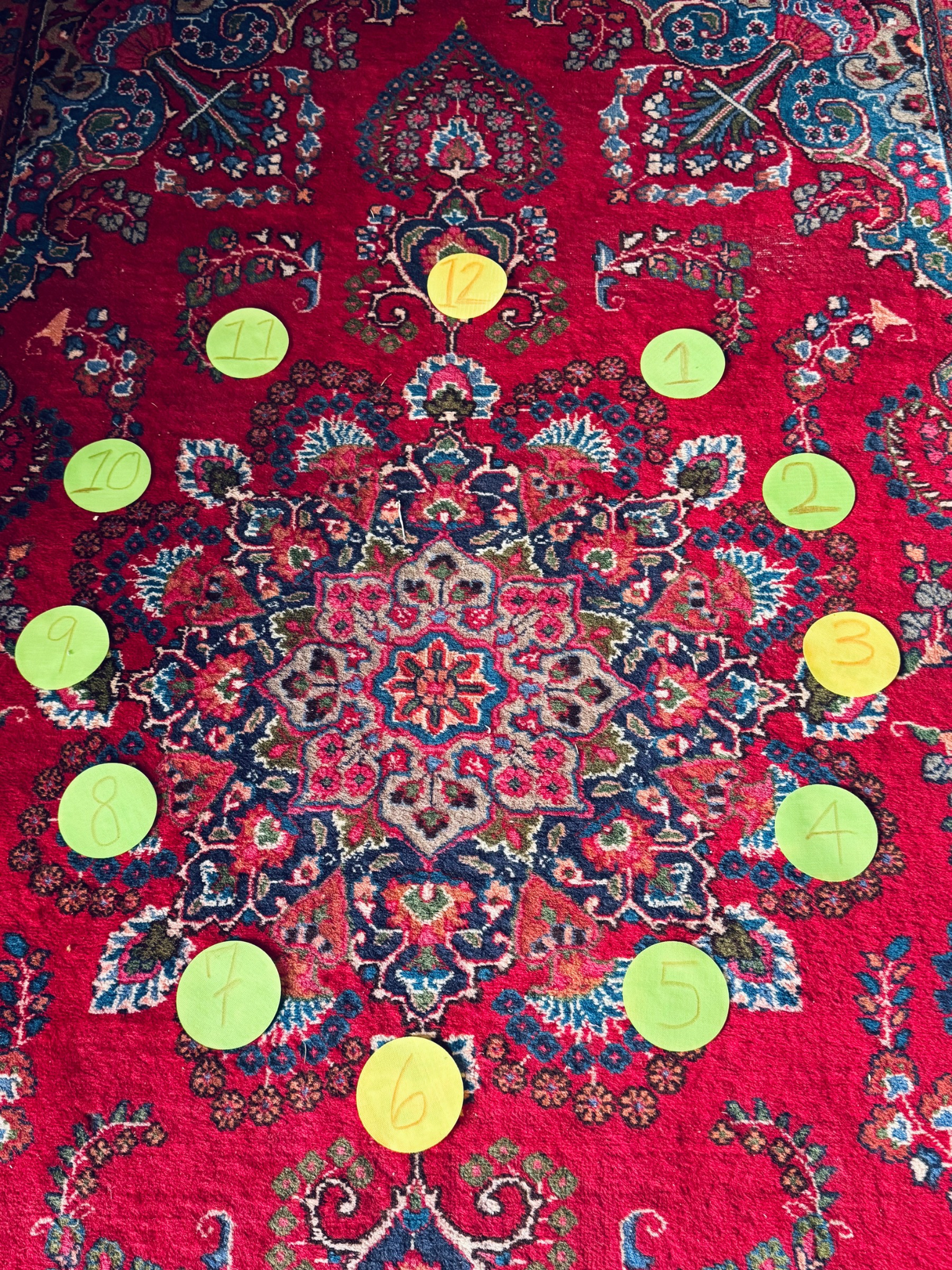
Create a circle on the ground using carpet stickers, street chalk, string, tape etc, that is big enough for them to walk around acting out the second hand of the clock.
Play “The Syncopated Clock” while walking rhythmically to the beat around the clock. You can even clap or use rhythm sticks to actively tick the beat. Reinforce that this is the seconds ticking by and make sure to keep moving and keeping the beat, even when the clock tick goes quiet!
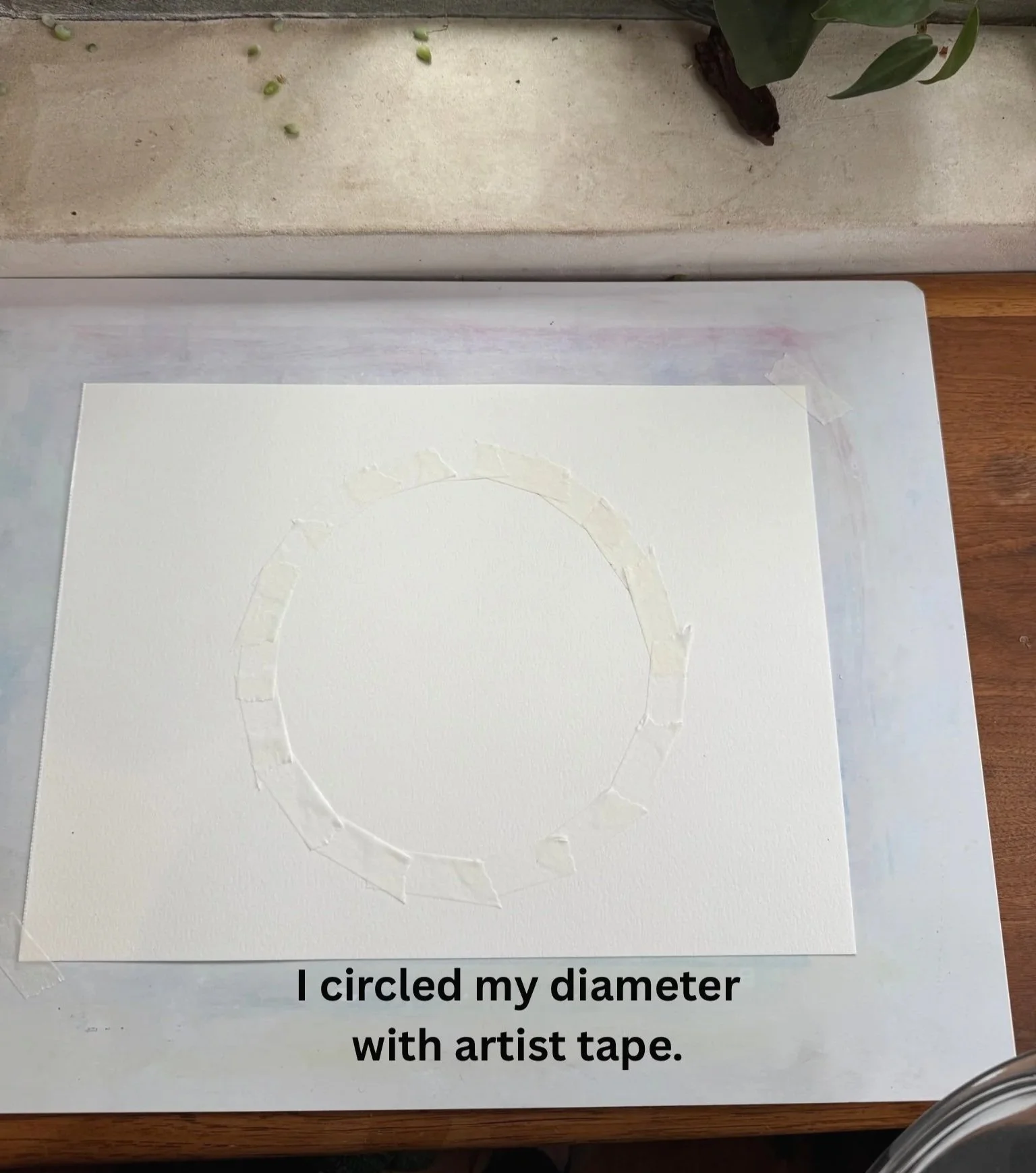
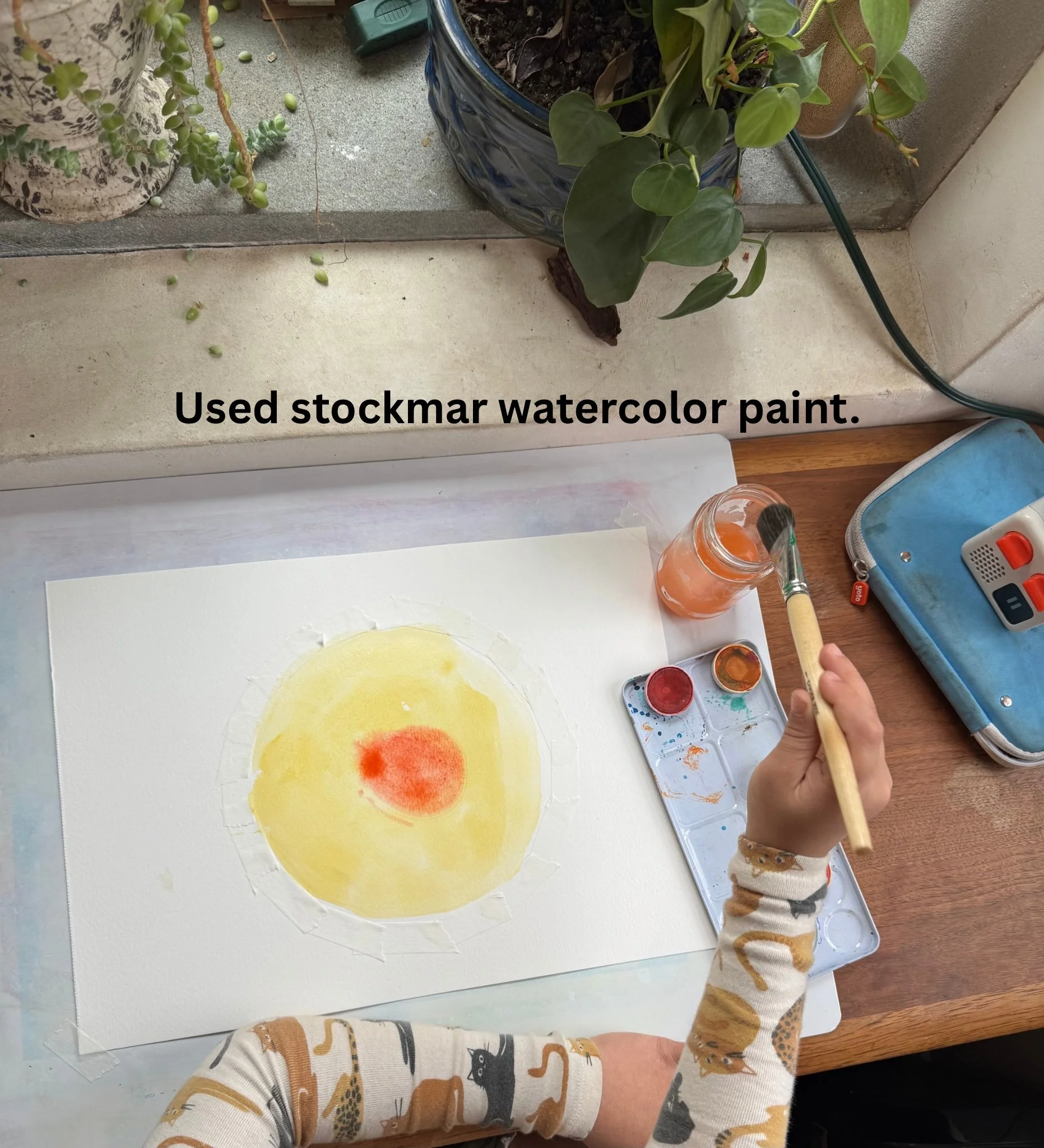
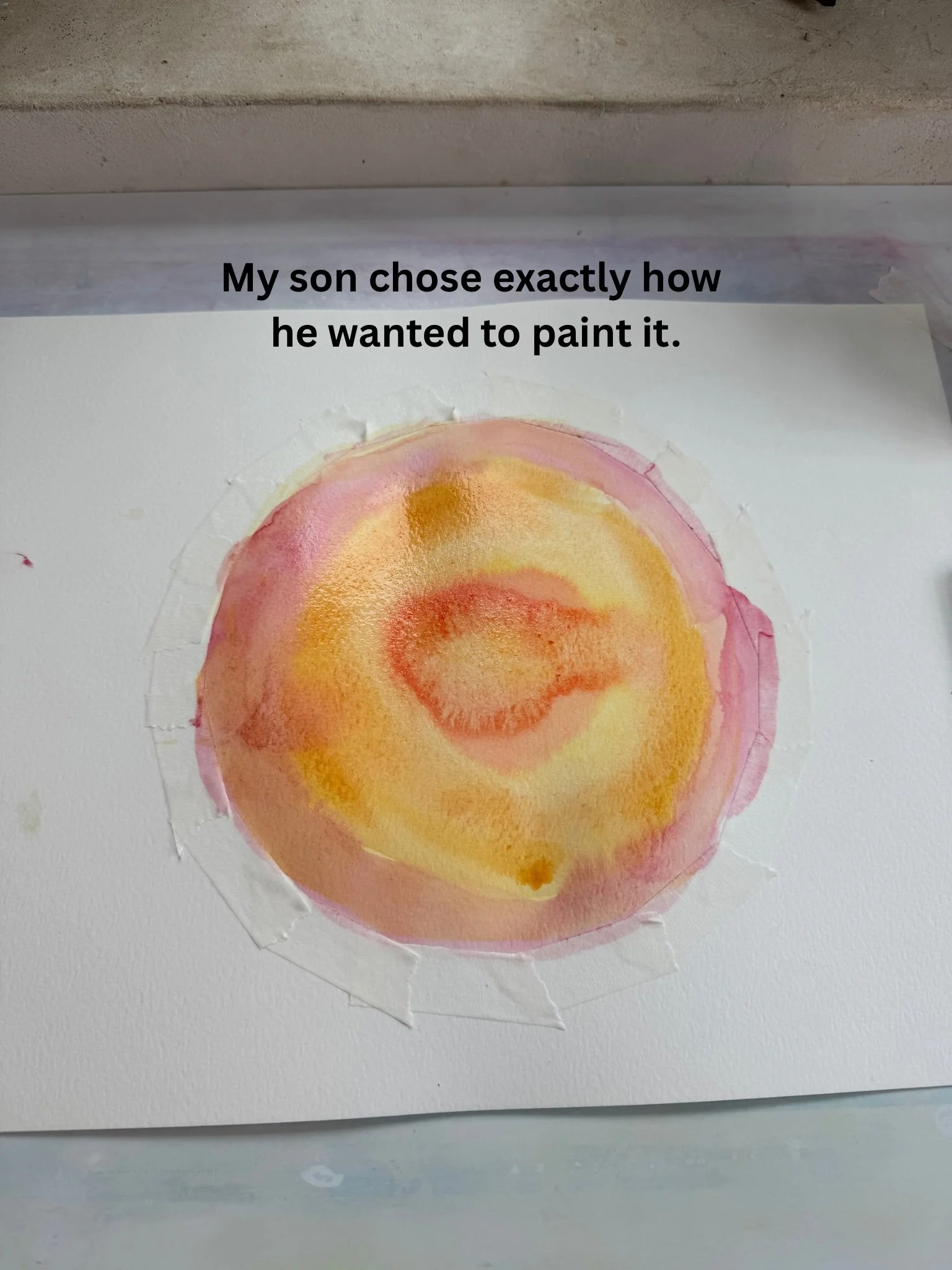
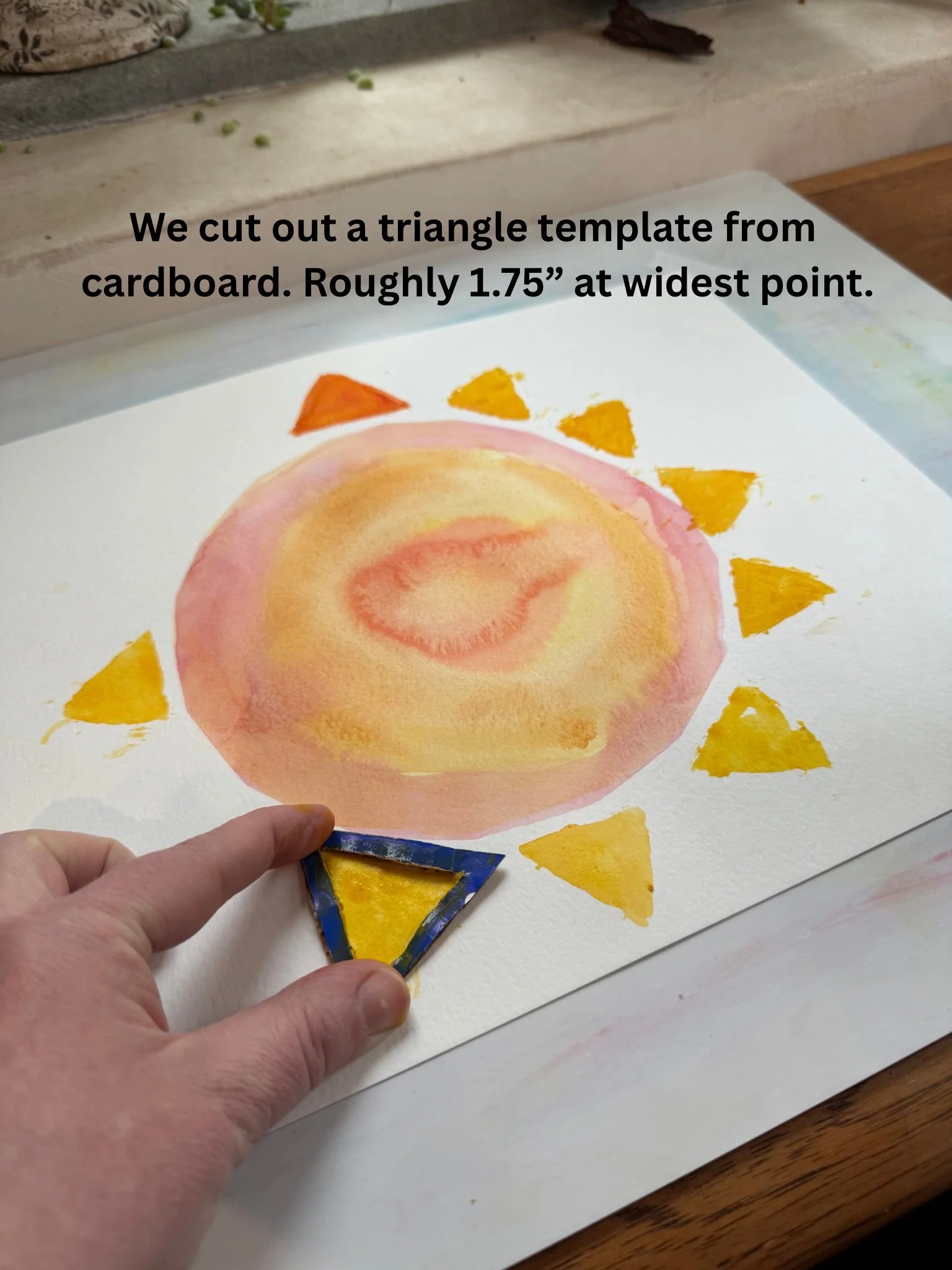
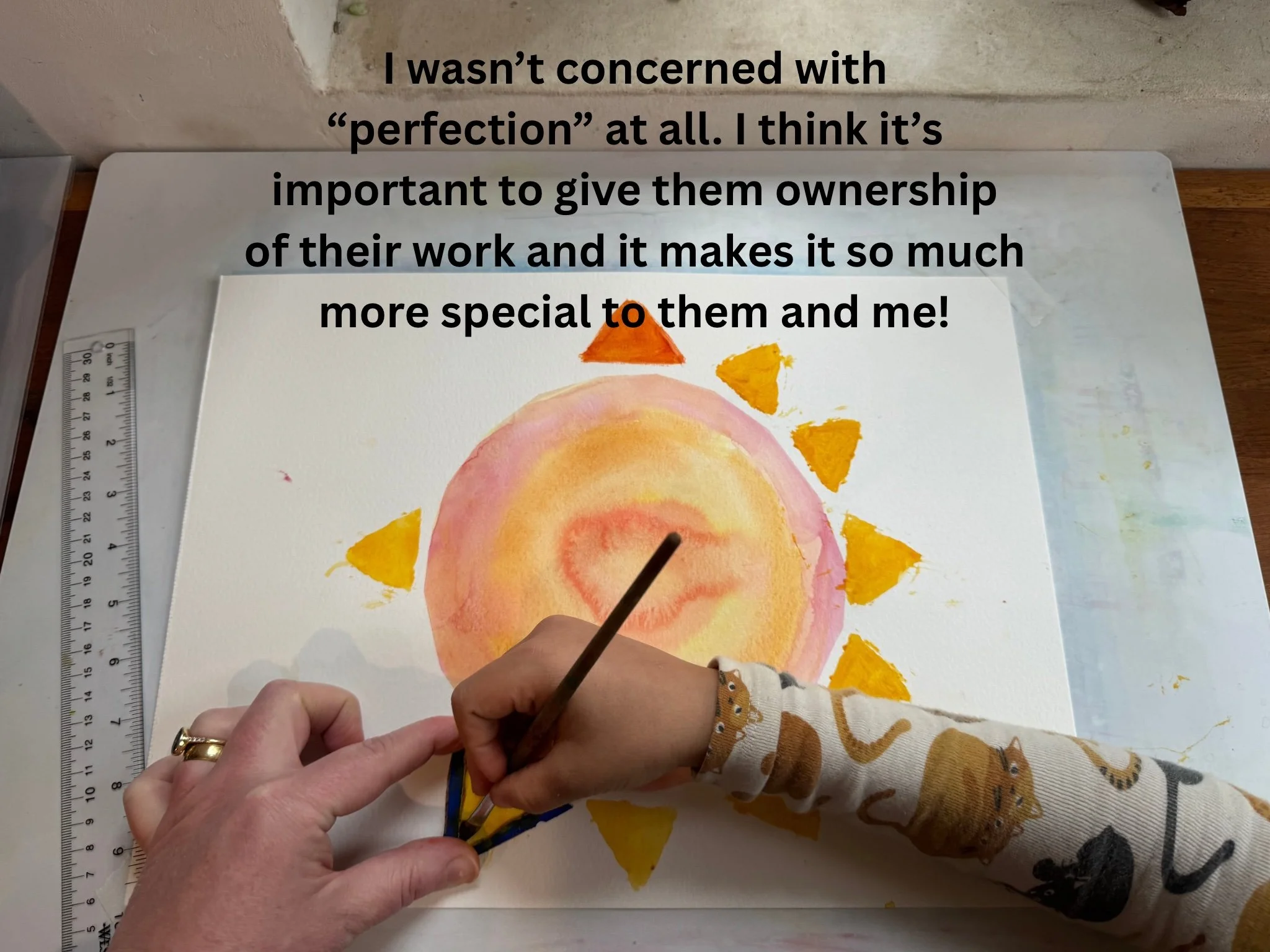
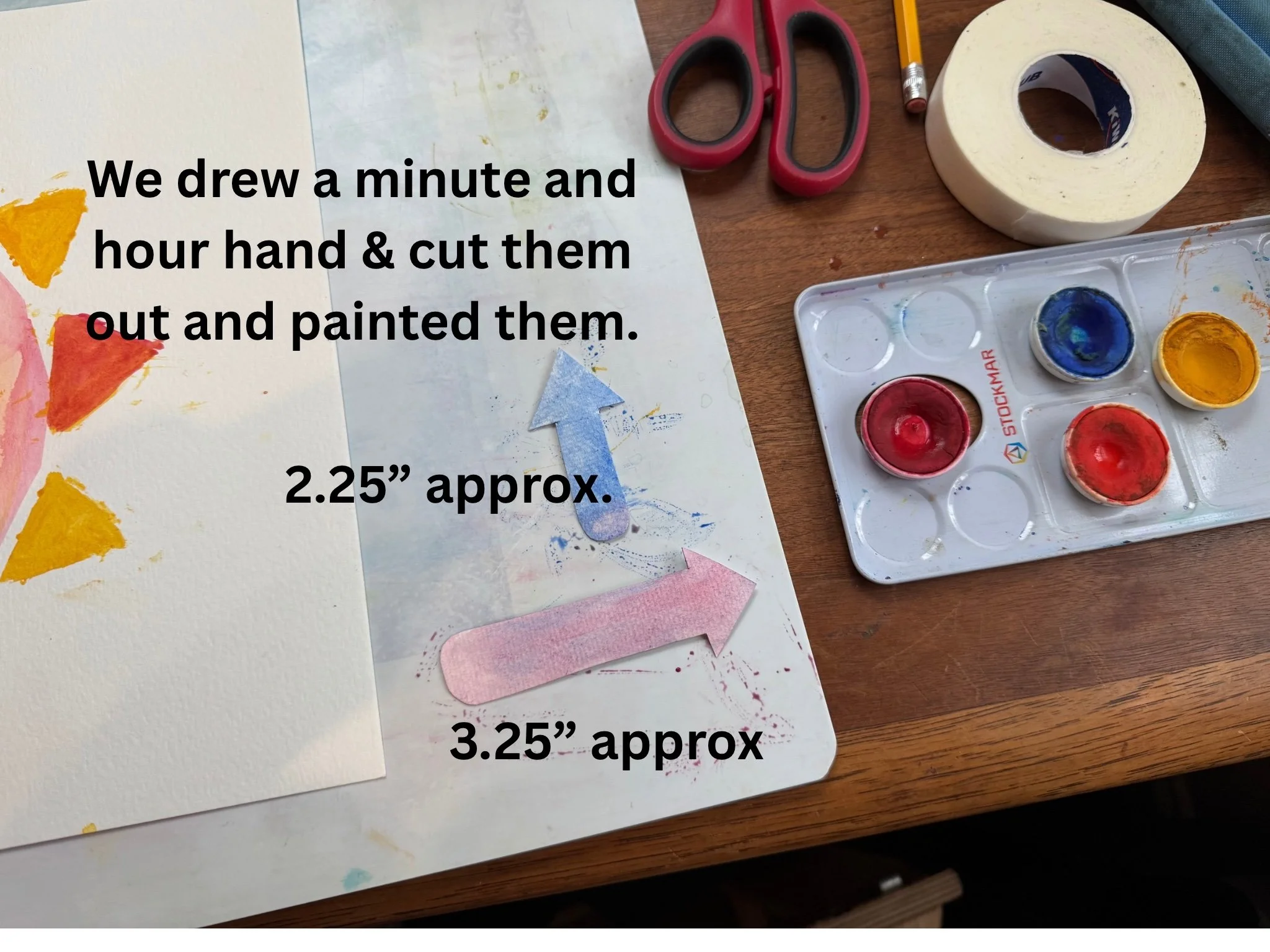
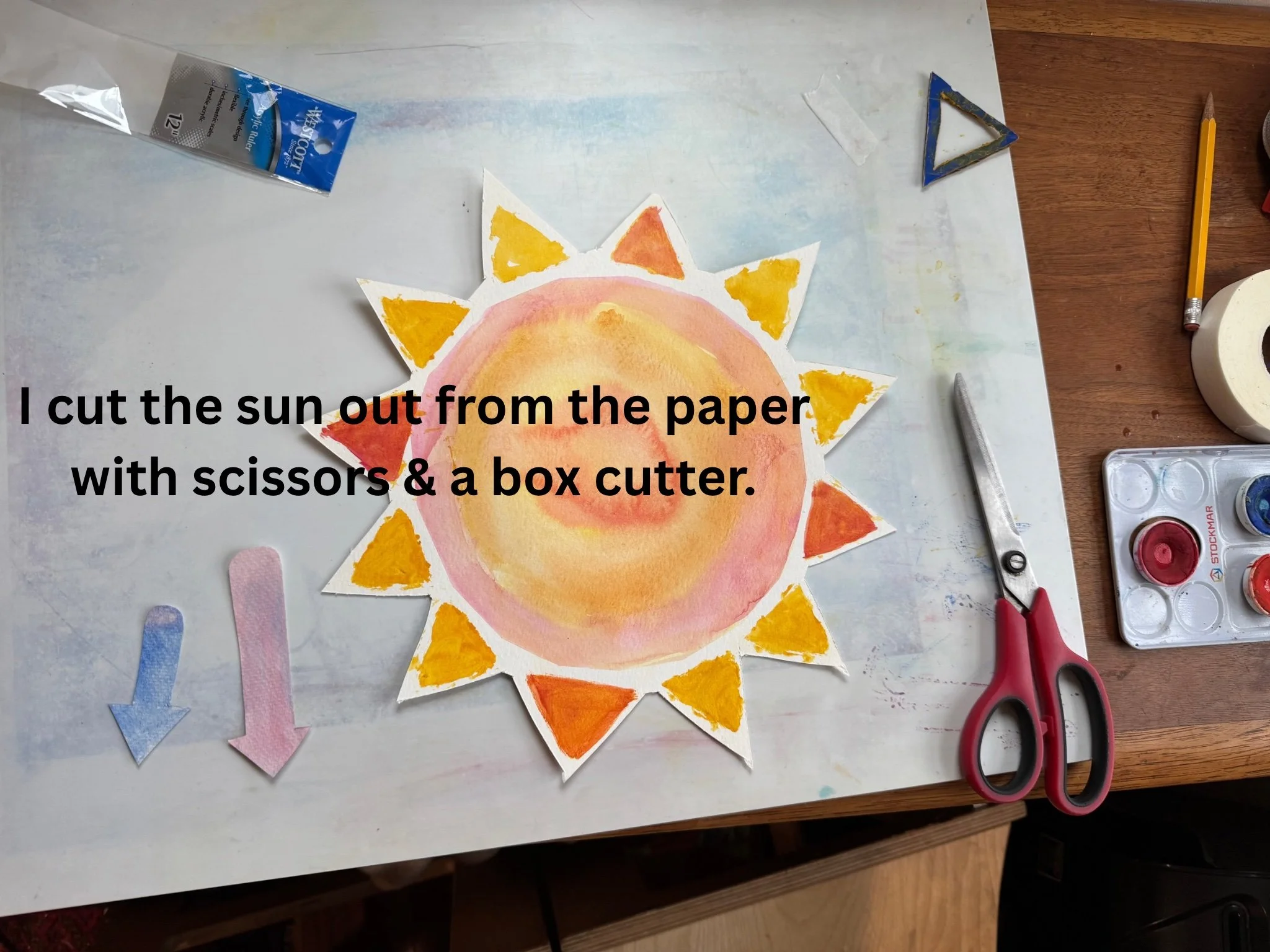
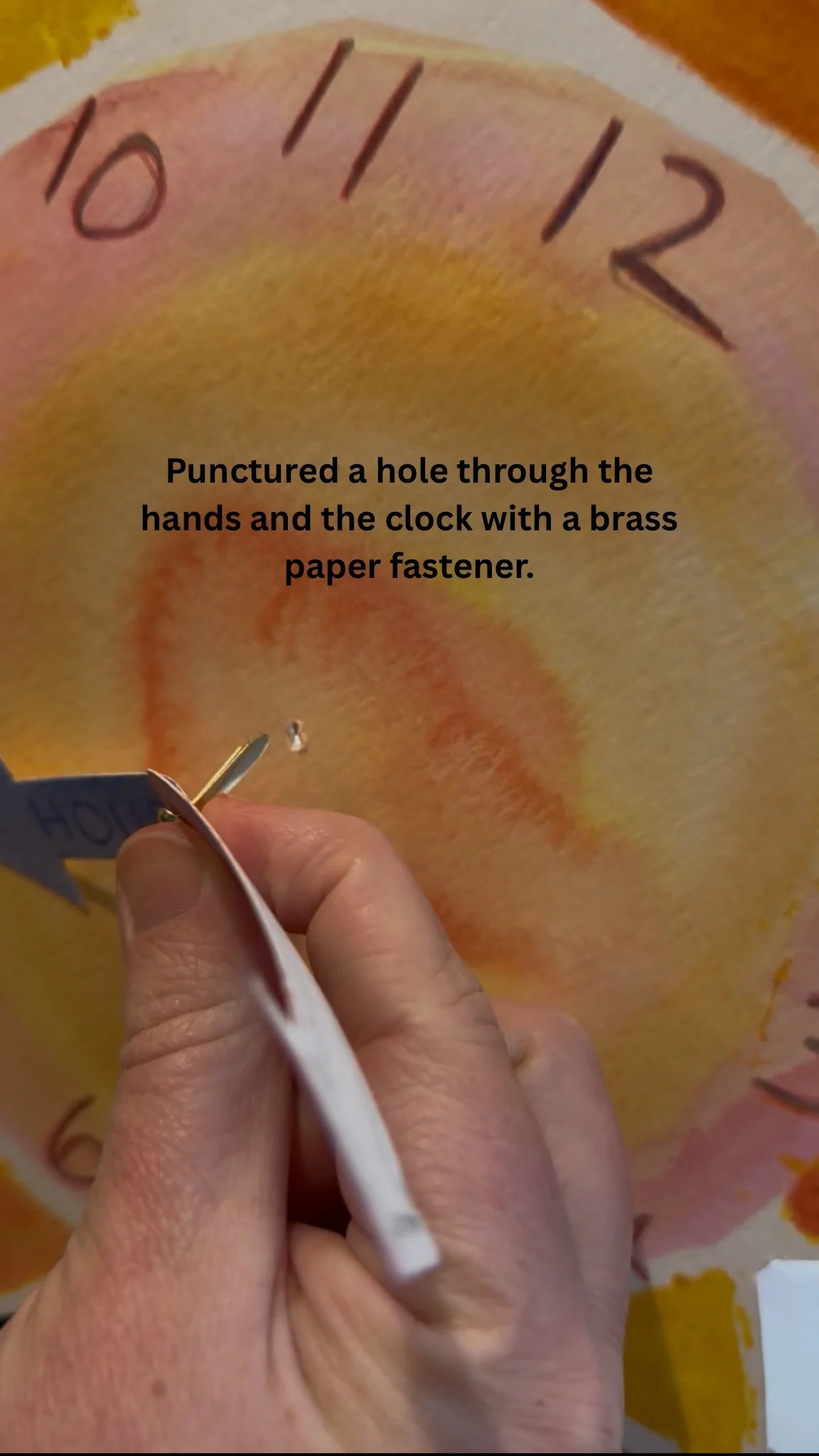
Making a Movable Clock
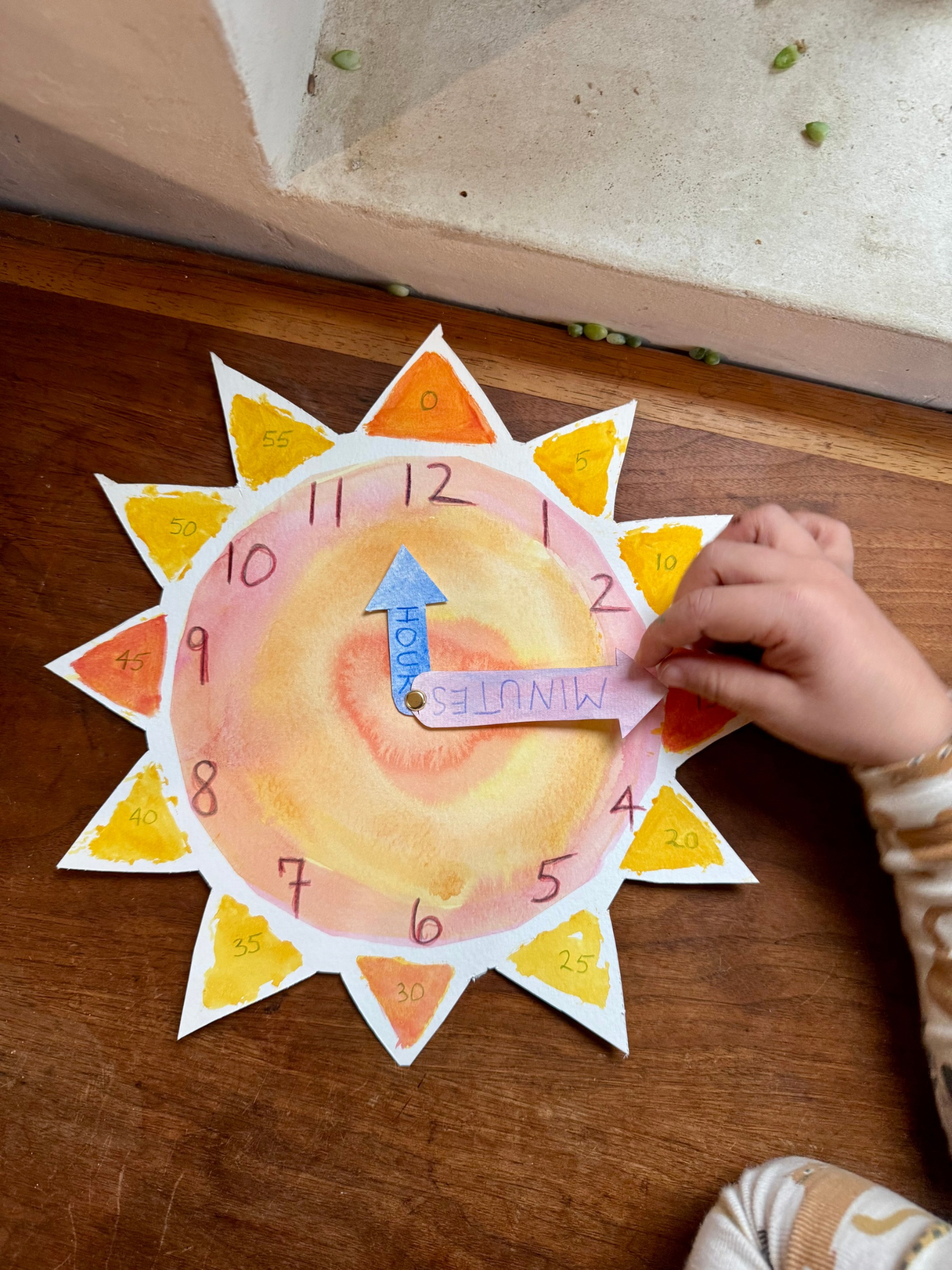
I got the inspiration for this clock from Pinterest. There are many amazing versions!
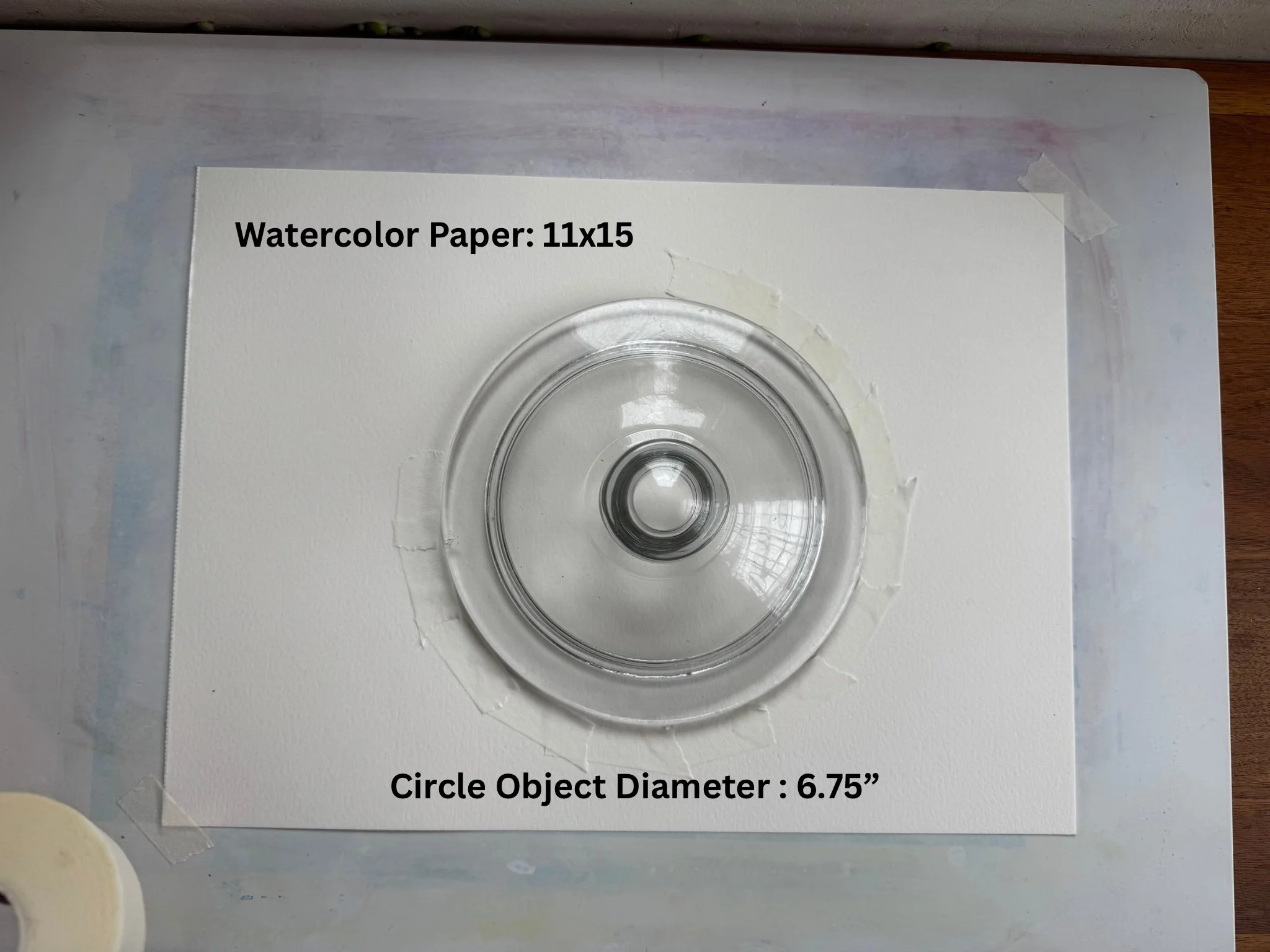
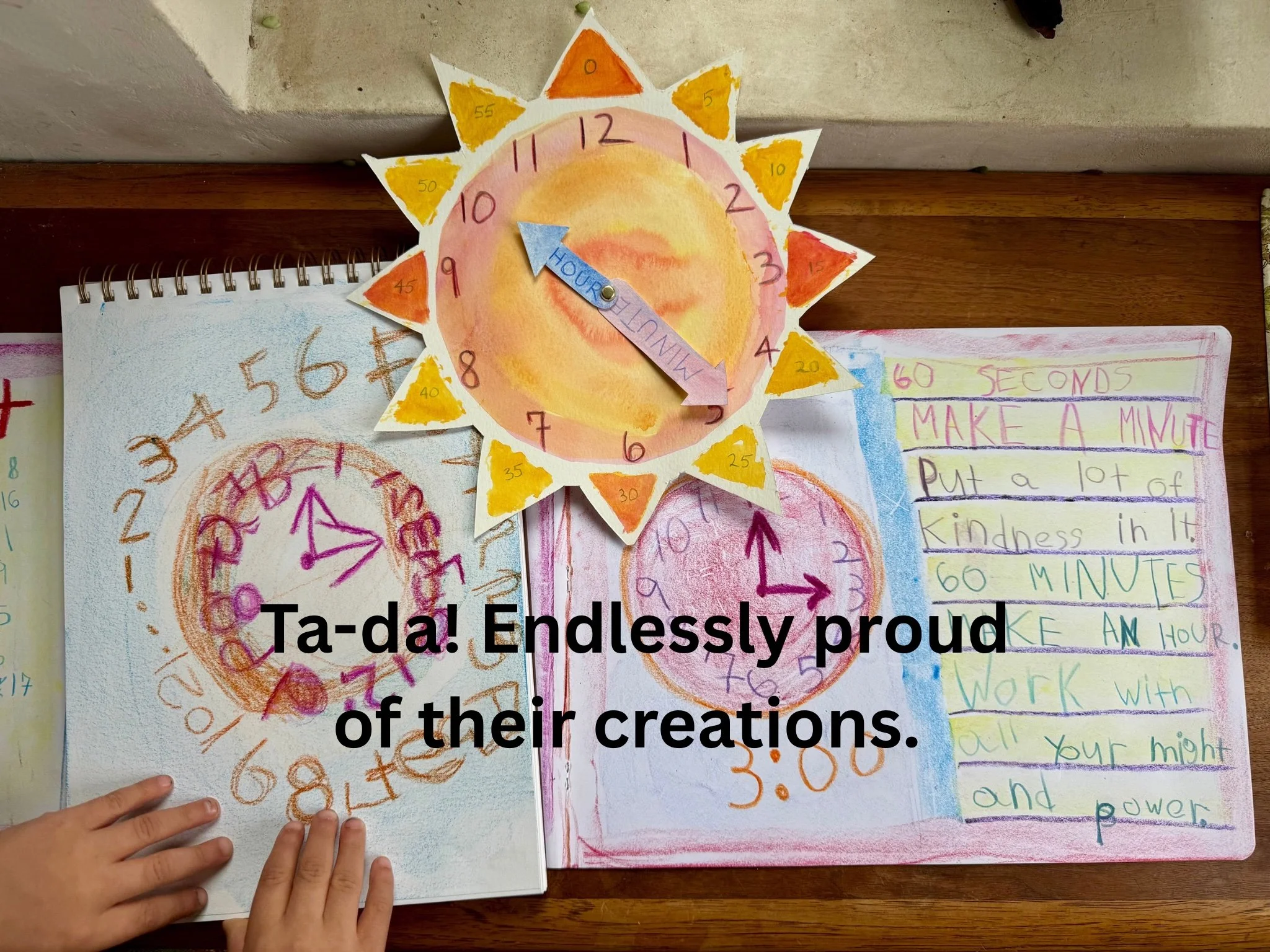
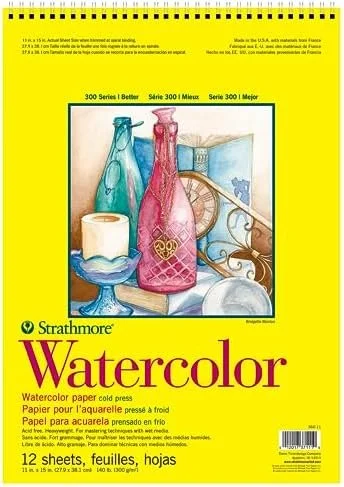
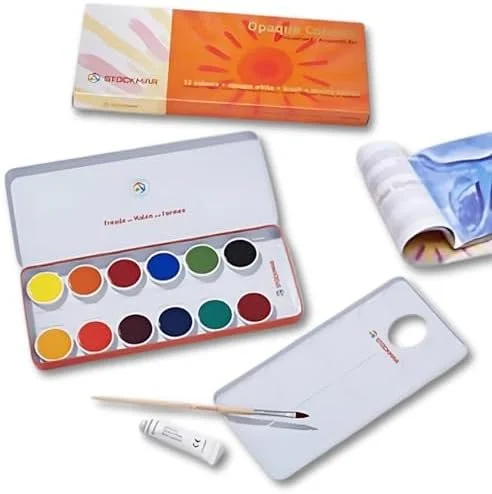
Supplies We Used To Make the Clock
This post contains affiliate links. If you purchase through them, I may receive a small commission - at no extra cost to you. Thank you for supporting my work!


If you would like to read more about our homeschooling journey, I wrote a blog post here.
If you enjoy my content, please consider sending me a “virtual coffee,” to help sustain this blog and enable me to create more wonderful free content! I so appreciate it, and am truly grateful for everyone who has supported my work either monetarily or by sharing it with others. Thank you!!
My Why Behind Musical & Creative Homeschooling
Some of the most frequent questions I receive are about homeschooling, so I thought I would delve into this topic a little more today and share some of my thoughts, how our homeschooling journey began and books/supplies that we have loved using in our homeschooling. And my new YouTube video where I chat more about homeschooling. :)
“A child’s mind is not a container to be filled but rather a fire to be kindled.”
-Dorothea Brande
I love this quote so much because I think it encapsulates everything I think learning should be. Learning should be encouraging the innate curiosity in every child and their sense of wonder and desire to do meaningful and beautiful work.
My journey into homeschooling began when I became pregnant with my first child. I think like most parents, lots of soul searching and researching took up a lot of my headspace (and it still does - never goes away!); deciding who you want to be as a parent, how to do the best job, what to prioritize and what will be most important were/are constantly circling thoughts.
Growing up, I was already somebody being deeply formed by music, literature and art, though I didn’t realize that as a child. I had a father who would recite poetry at the drop of a hat, be able to rattle off the year a certain song came out and tell me exactly where he was and what he was doing when the song came on the radio. Combine that with a house full of books, art and music instruments and you will get the picture.
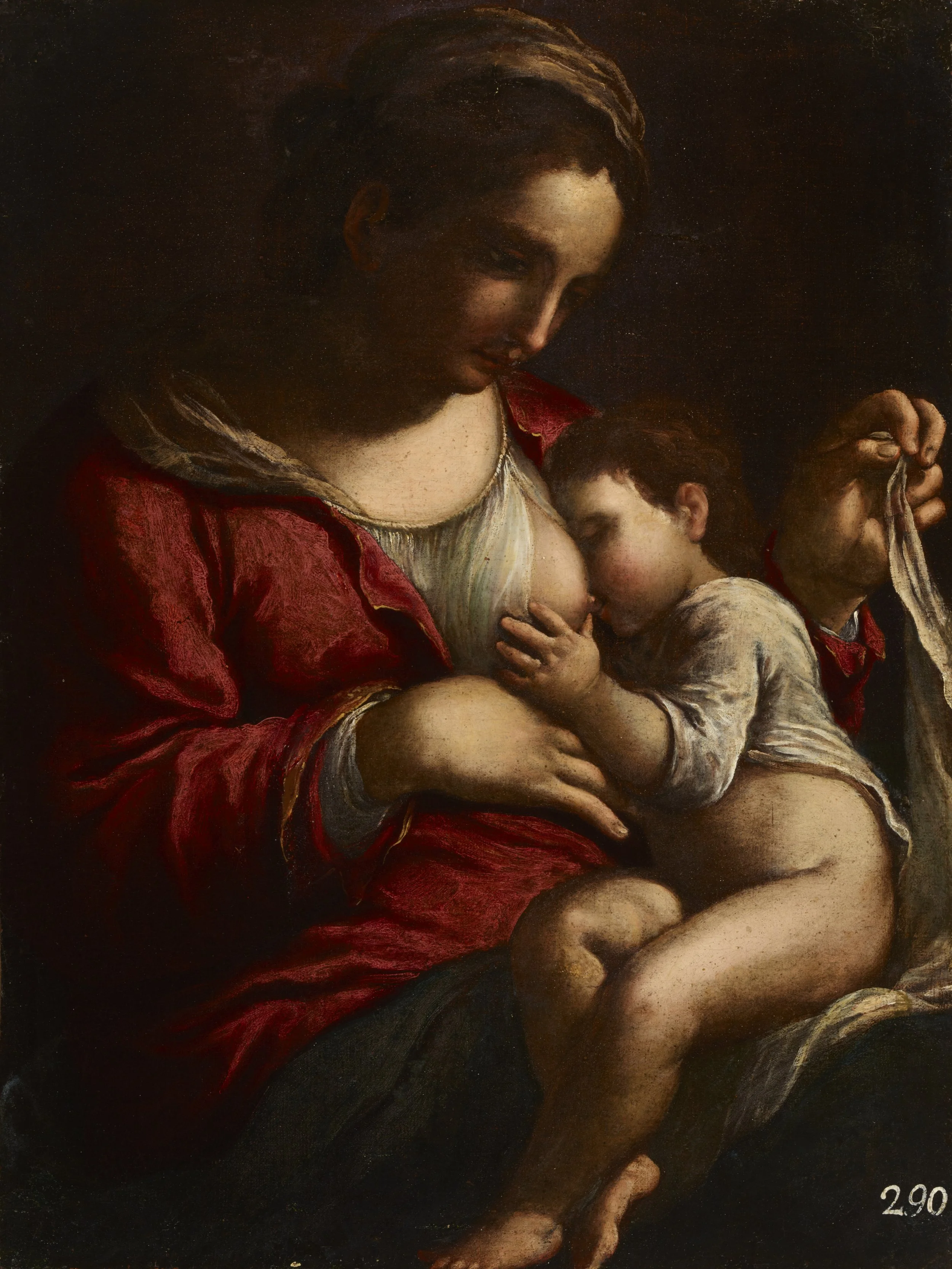
If you were to take a walk through my parents’ house you would be astounded at the number of sacred art pieces everywhere. It’s like a museum. If you saw the number of books… you would probably faint! When I say that music, literature and art are deeply formative, I speak from experience.
My father who worked an extremely hard and dangerous blue collar job his entire life in NYC is probably one of the most intelligent people I know. He prioritized music for me and my siblings and made sure we got our piano lessons, our Irish music lessons, Irish dancing classes, language classes…and so many other things that would be so unexpected you wouldn’t believe.
My mother was born in the Irish speaking part of Ireland, known as the Gaeltacht. Growing up in this strong cultural community, music, especially sean-nós, story telling, and dance were integral parts of the community. I grew up listening to Irish music, the Irish language and spent much of my childhood visiting Ireland and being deeply impacted by the culture. I remember falling in love with the Irish harp at a young age and here I am all these years later teaching an Irish harp ensemble in New York City. I am just always in awe contemplating how the childhoods we have, deeply impact our adulthood in so many ways. In ways that are probably still even unknown to many of us.

It’s probably why I spend so much time speaking about the ways things were done in the past that were of true value; not because I over idealize the past, but because I think tremendous wisdom can be found from reflecting. I know that there was unspeakable hardship generations ago; but the point I make is that these generations came out resilient, hard working and appreciating the true things in life that are of value. We have started to lose so many of the good ways of our ancestors that made life truly beautiful and meaningful. The appreciation of good song, good story, good food and good company were what gave people purpose to get through the hardships of life with a smile on their face.
We have the blessings and luxury of many incredible things about modern life, and yet we have grown vastly disconnected, unhappy and anxious as a society. You think that running hot water and electricity would make most people happy, but the reality is that what makes people happy or contented is far more deeply rooted and value based. If we don’t have morality, ethics and appreciation of what is good, beautiful and meaningful it does not matter one iota how much money we have in the bank or the square footage of our house.
I want to share a quick story with you all. Since my father loved books he had collected quite a collection of the Classics by the time I was reading. We didn’t own a television for a large part of my childhood, so I spent a lot of time reading as a child. I would often pick up the Easton press leather bound books from the bookcases and peruse through them. Most of them I would usually put back after seeing that the storyline was not something I was grasping, until one day I picked up a book with a rather startling title called, “To Kill a Mockingbird.”
I still remember to this day when I opened the book. I think I probably expected it to show pictures of mockingbirds in varying stages of demise or something else equally literal, but was pleasantly surprised to see the book started from the viewpoint of a child. A girl named Scout. I was pleased with my luck that I had landed on a children’s story (so I thought) and read the entire book within about a week. I had absolutely no idea what the book was truly about. I was probably about 9 or 10. I had loved it! I had interpreted the book purely through the innocent viewpoint of a child. I had taken from the book what I could, and what couldn’t be fully interpreted sat there in my mind till many years later…
The reason I share this story is because this is one of countless examples I had growing up where I was exposed to literature, music and art that was beyond what I could fully appreciate or understand at the time. But that wasn’t the point. It’s never the point. The point was that the seed was planted and I was given ownership of all this great work. I was formed by beauty without even knowing it.
I say all this, because I think if anything, childhood is so completely overlooked and under-respected. Everything has been dumbed down, sterilized, and demystified and it just completely misses the point. The point is to plant the seeds. Not to expect immediate results.
So coming back to where I started, when I was pregnant with my eldest, already having very set views on what I hoped to be like as a mother and how I wanted to raise our child, I was constantly looking for ways in which I could create a beautiful and magical childhood and be inspired.
I happened to come across someone who had sewed a gorgeous wool felt birthday crown for their toddler. I immediately thought it was such a thoughtful, heartfelt and truly unique thing to do and became curious about the tradition. I have always been someone who enjoys making things, even though I am no expert by any means, but it struck a chord with me.
As soon as I found out that these birthday crowns were called Waldorf birthday crowns I fell down the rabbit hole. I immediately appreciated the sense of beauty Waldorf education nurtures in everything. The simplest of acts and the most simple of work is done with such creativity and reverence and respect for childhood. There is also this standard of excellence that is very much aligned with Classical education in the way that it approaches learning. An emphasis on fairy tales, myths, legends, poetry, song and art are all pillars of Waldorf education. Great literature and art forms a basis on which to teach concepts and shape morality.
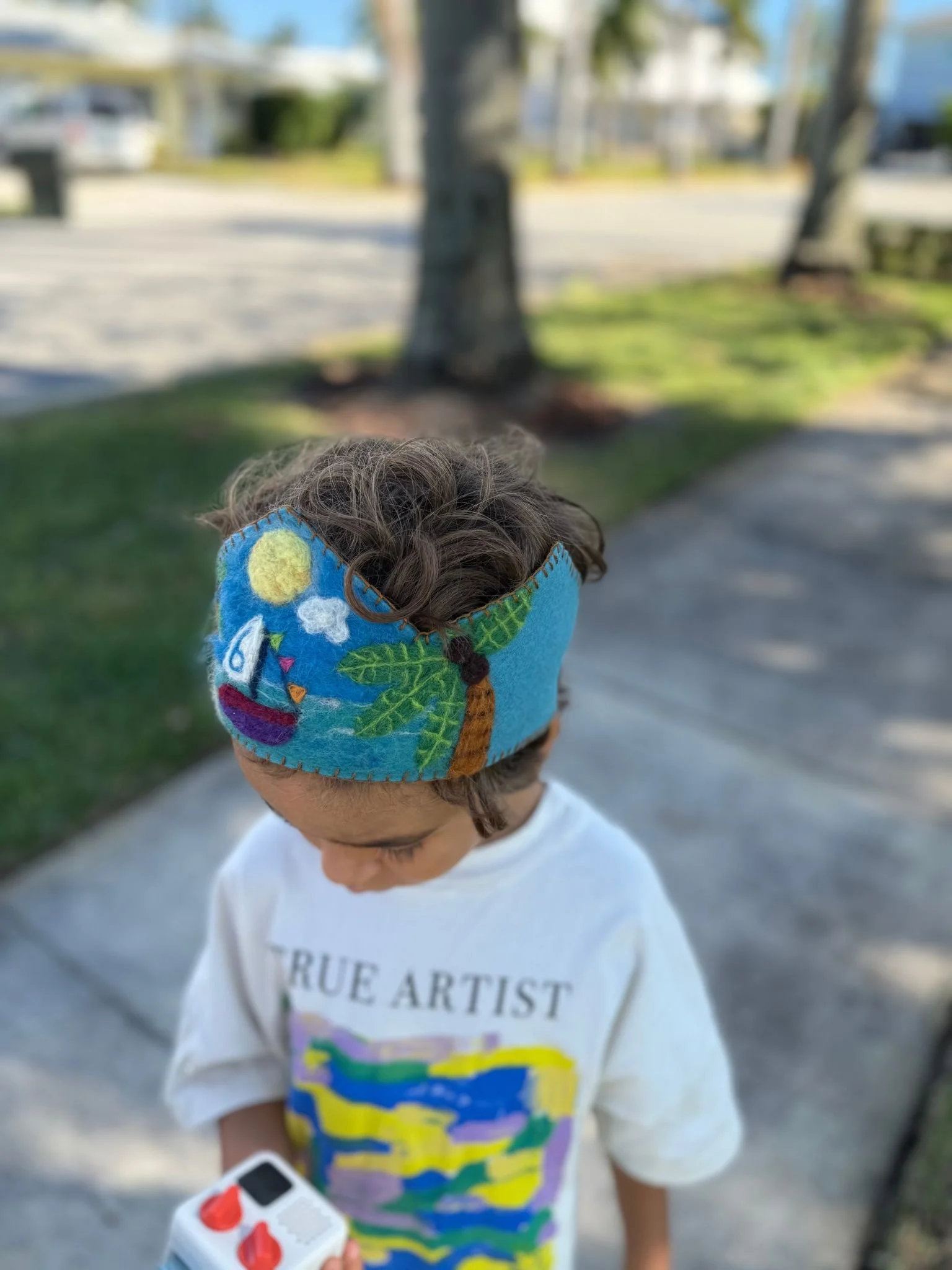
I resonated immediately with so many aspects of this philosophy and started to read so many books. Fast forward seven years and here I am having made 14 Waldorf birthday crowns, all inspired from that one woman sharing hers, for my own three children (a new crown for each birthday) and utilizing so many aspects of this educational philosophy in my own music method and our homeschooling journey.
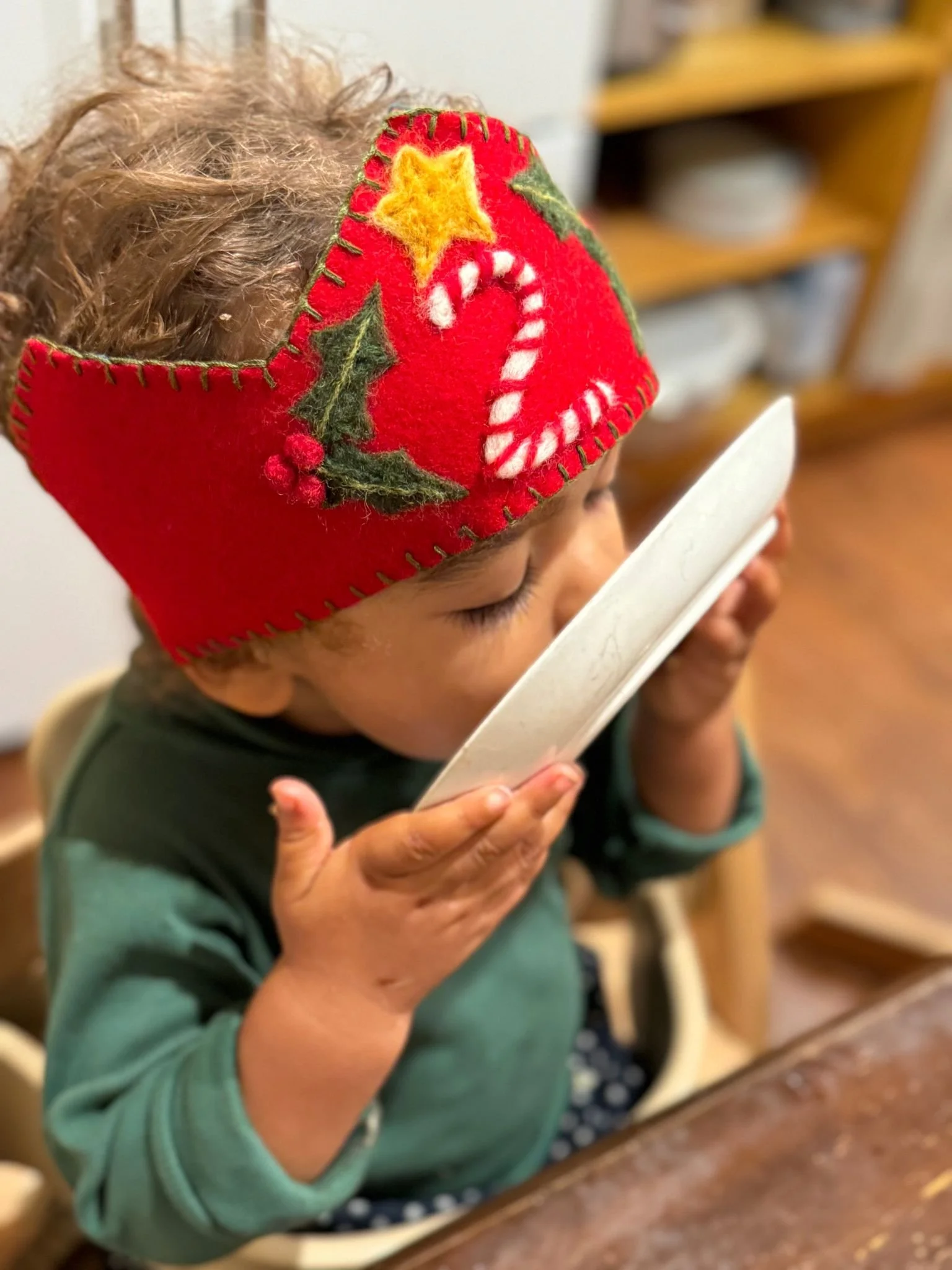
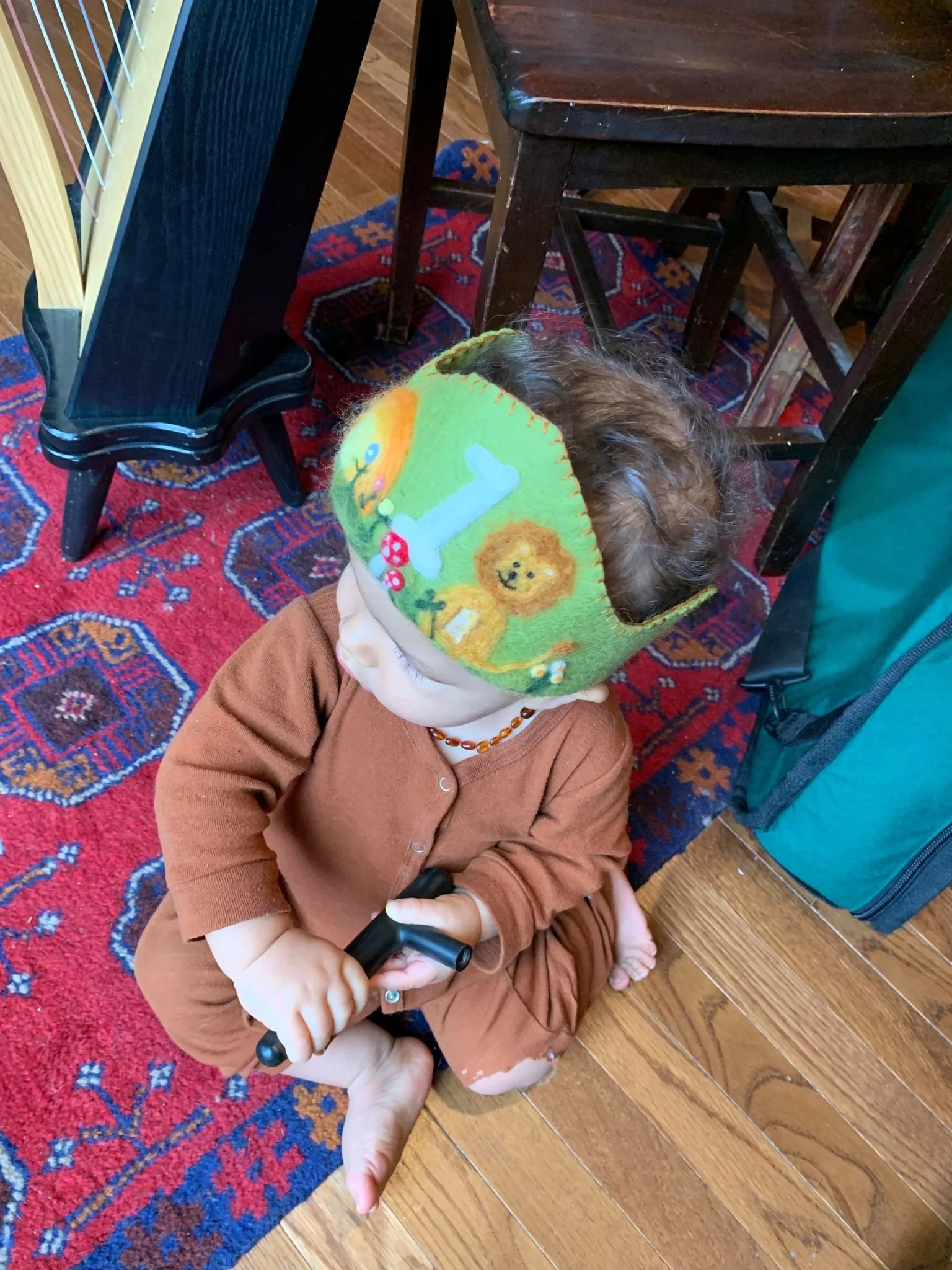
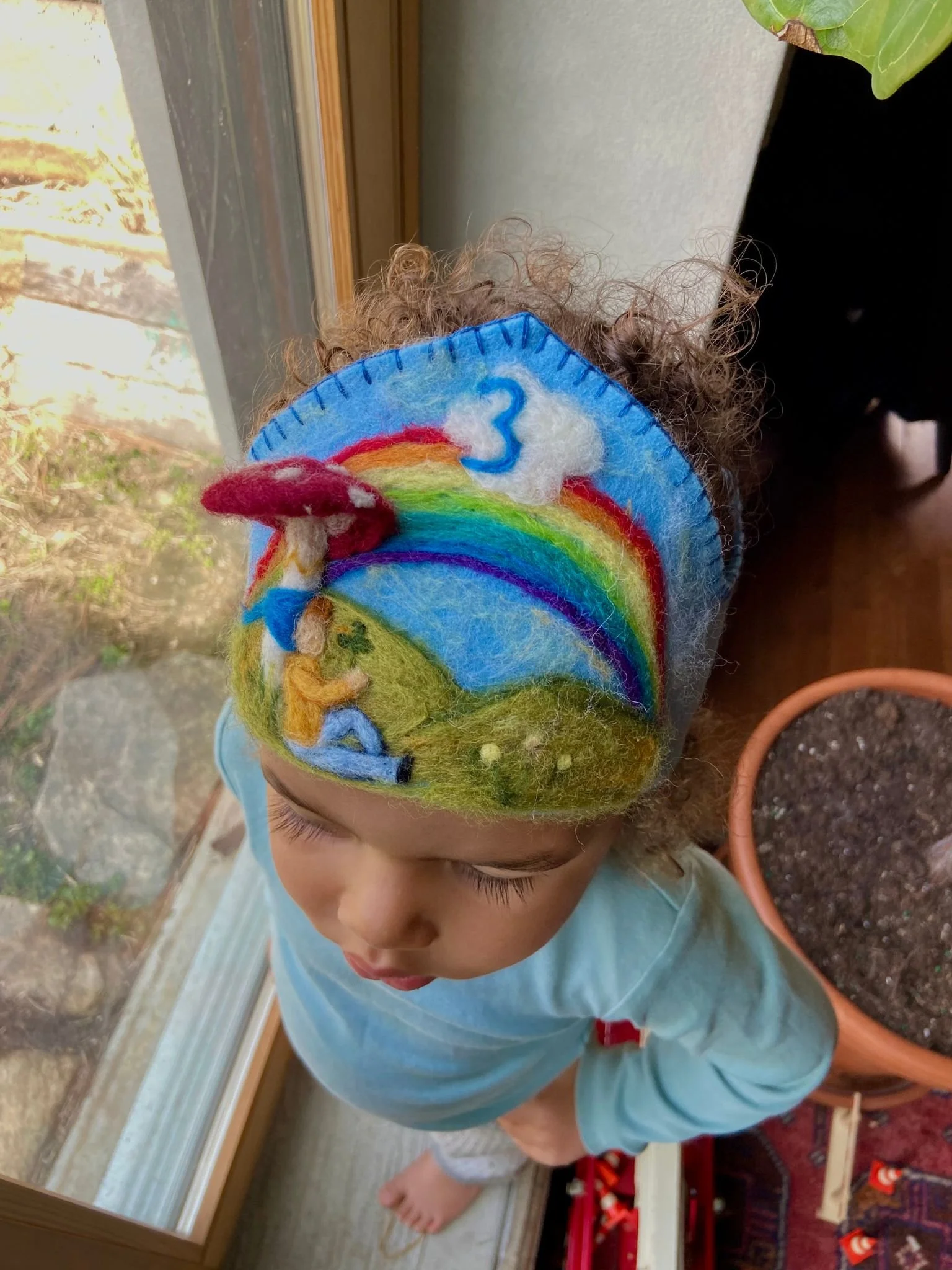
Now I want to preface the rest of what I am saying in that we utilize many things from Waldorf education, but I am no Waldorf expert or teacher. These are are all my own perspectives and interpretations. I have come to discover that I like to blend many things because there are so many wonderful ideas, and methods - from Charlotte Mason to Montessori, and Classical education. So this is what you will find when I talk about our homeschooling journey. My only dogma is that what I teach be taught with a sense of wonder, beauty, creativity and respect.

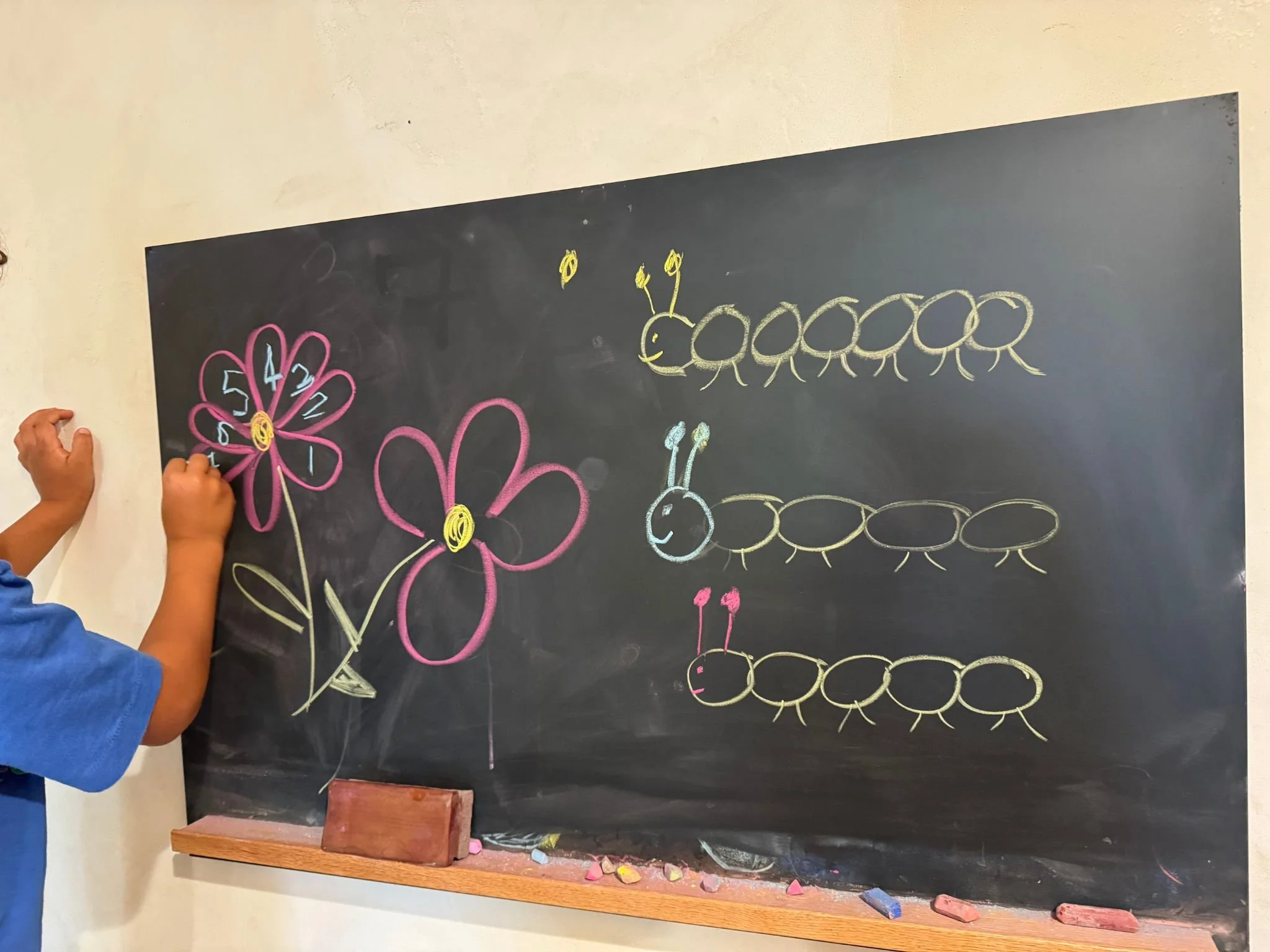
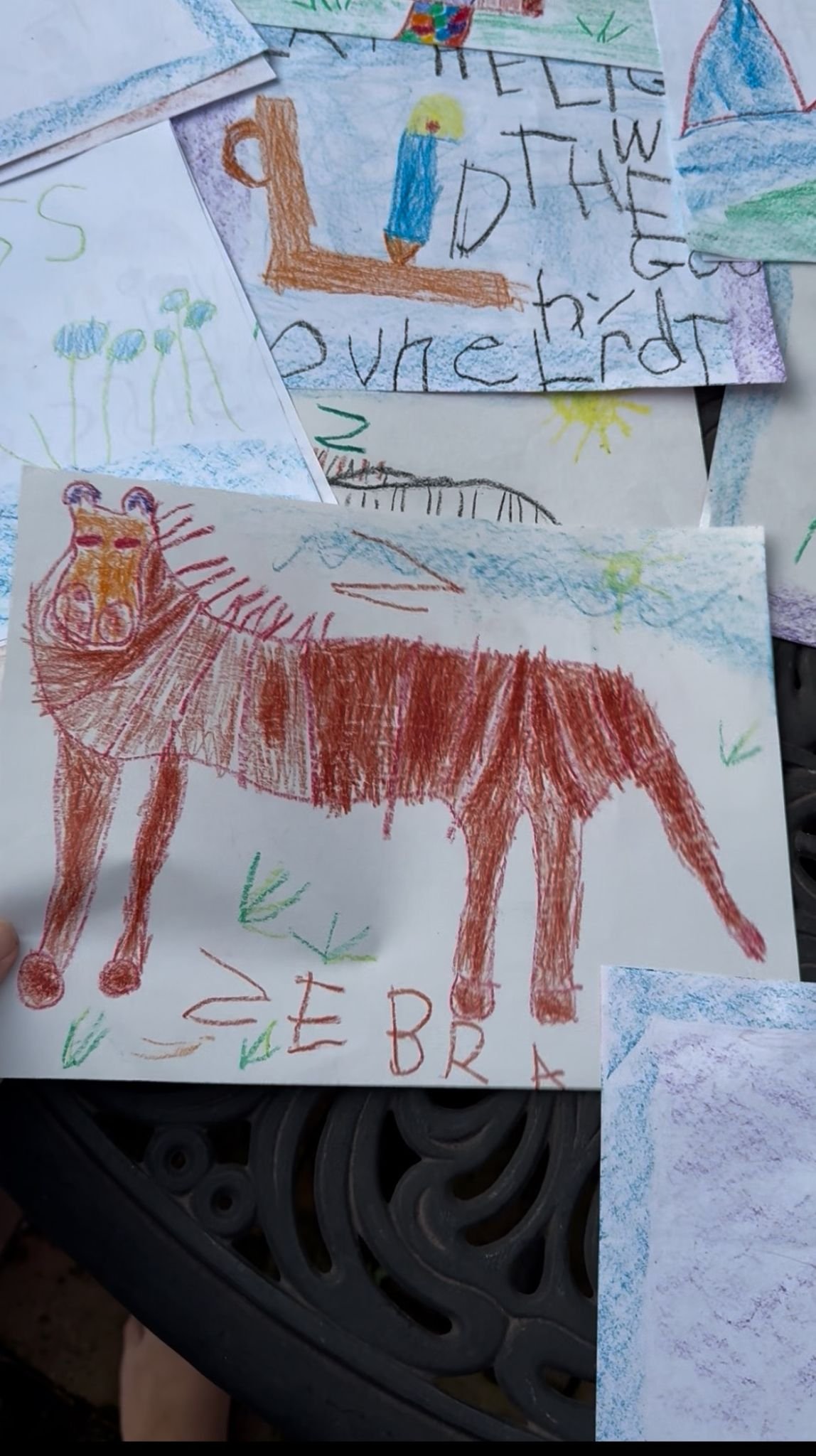
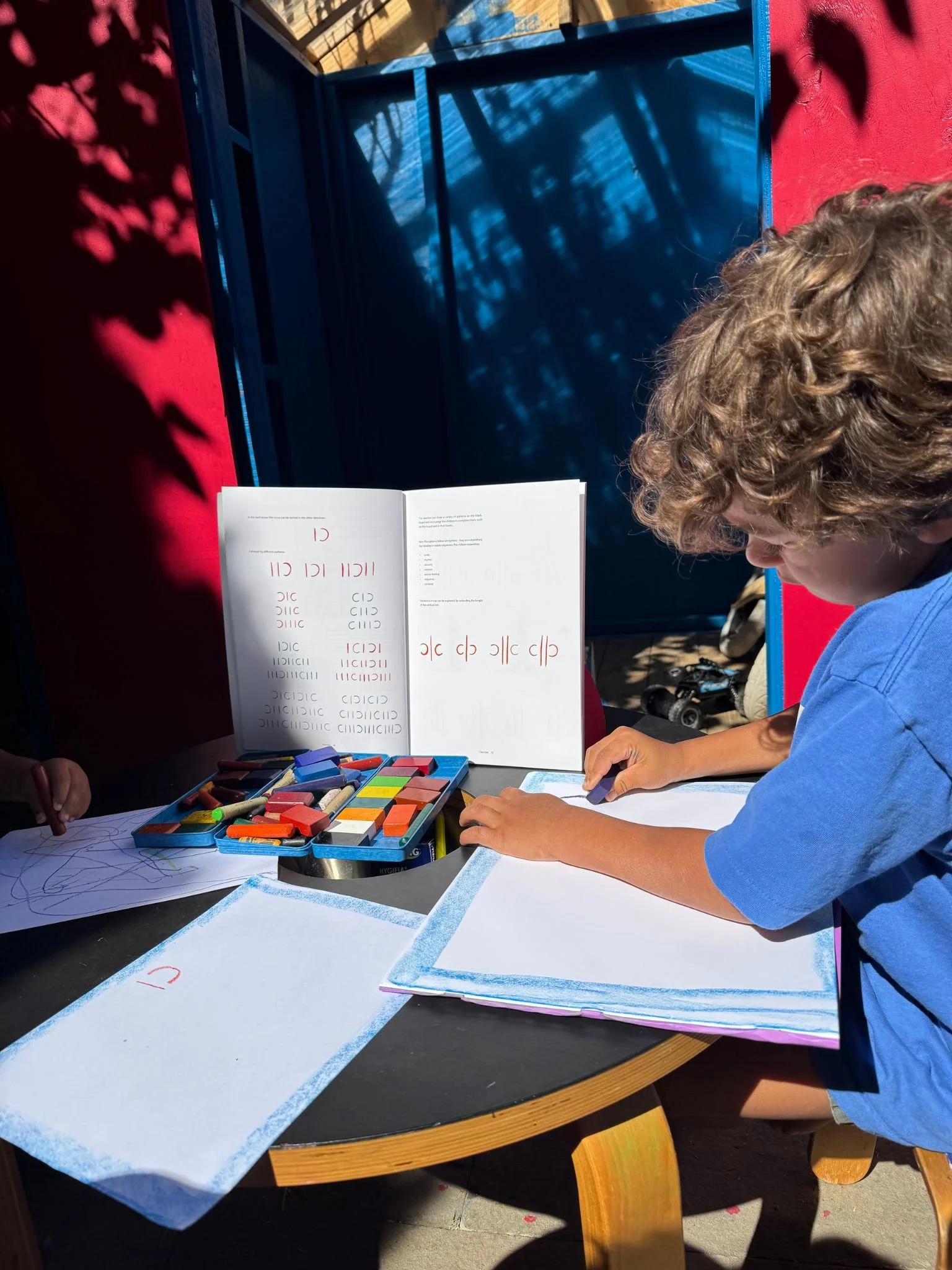
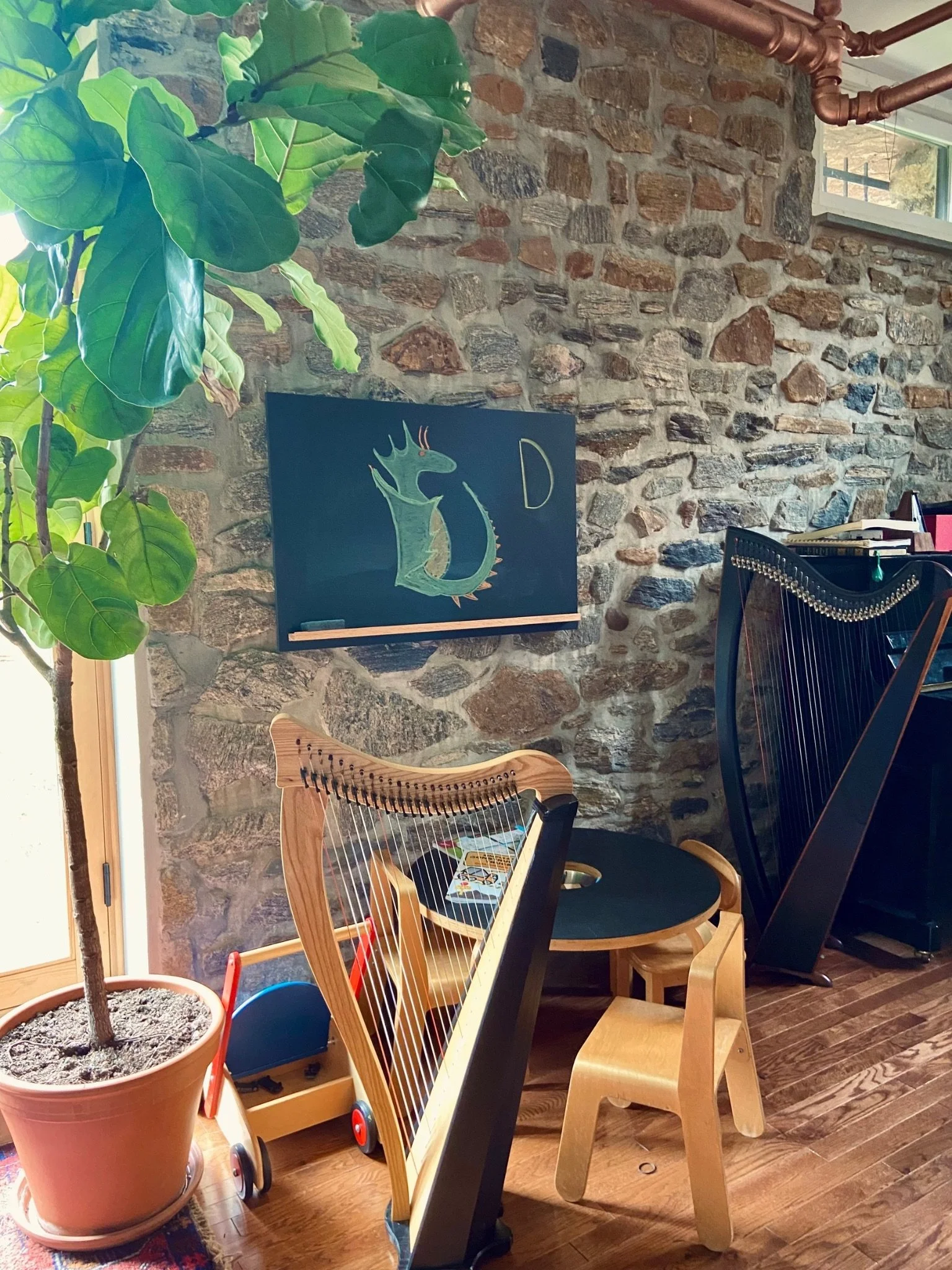
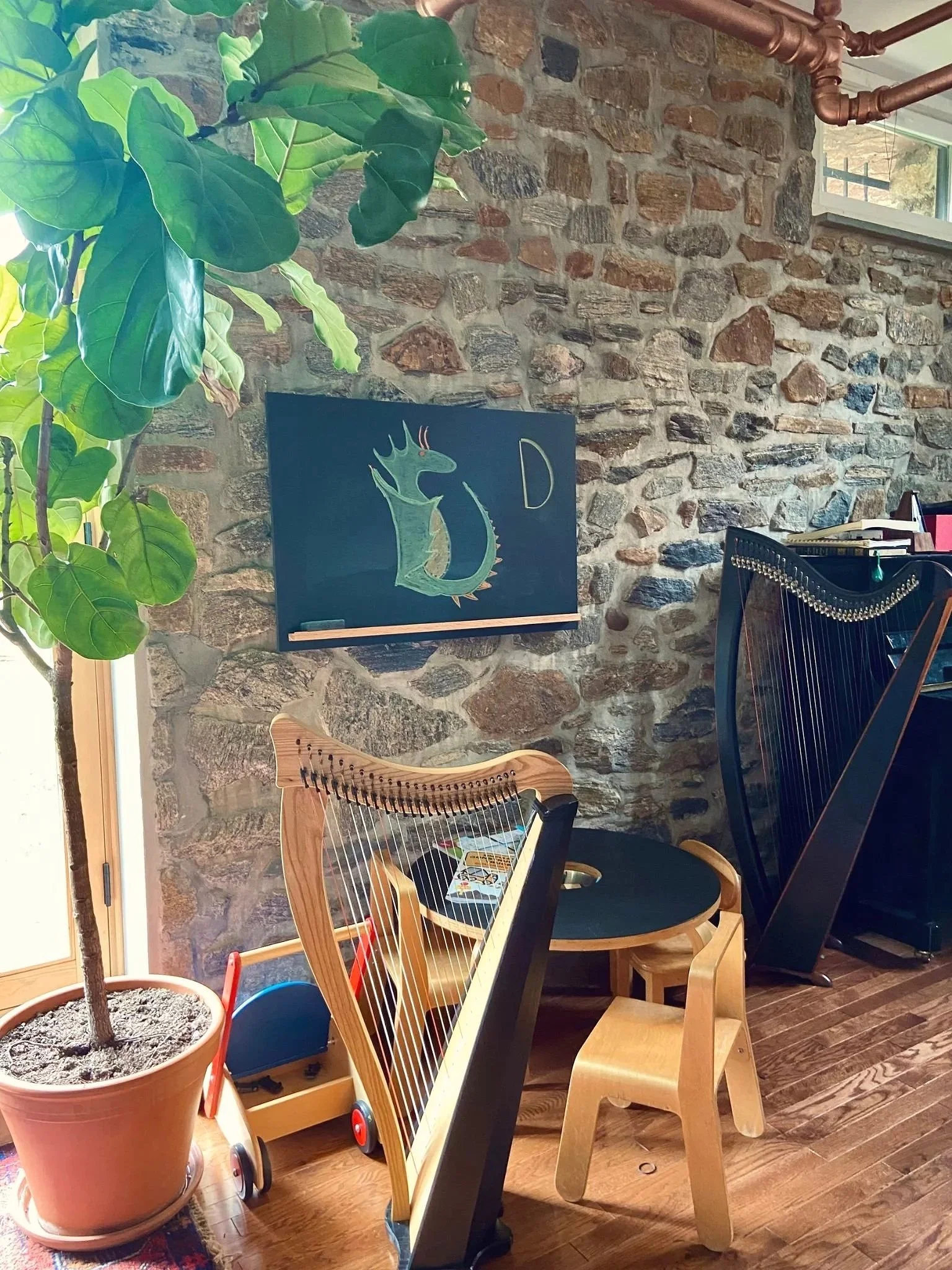
When we “formally” began learning with my eldest, I started teaching letters (sounds and formation) in the Waldorf manner. Each letter of the alphabet is introduced with a story and pictorial drawing of the letter.
Developmentally this makes so much sense. Just think to Ancient Egypt and some of the first writings were pictorial- hieroglyphics. Children also develop their sense of meaning pictorially. Letters are abstract to them and bear no significance to them in their understanding of life. By making the letter into a picture, it gives the letter meaning. And the picture often comes from a story that inhabits the physical nature or qualities of the letter.
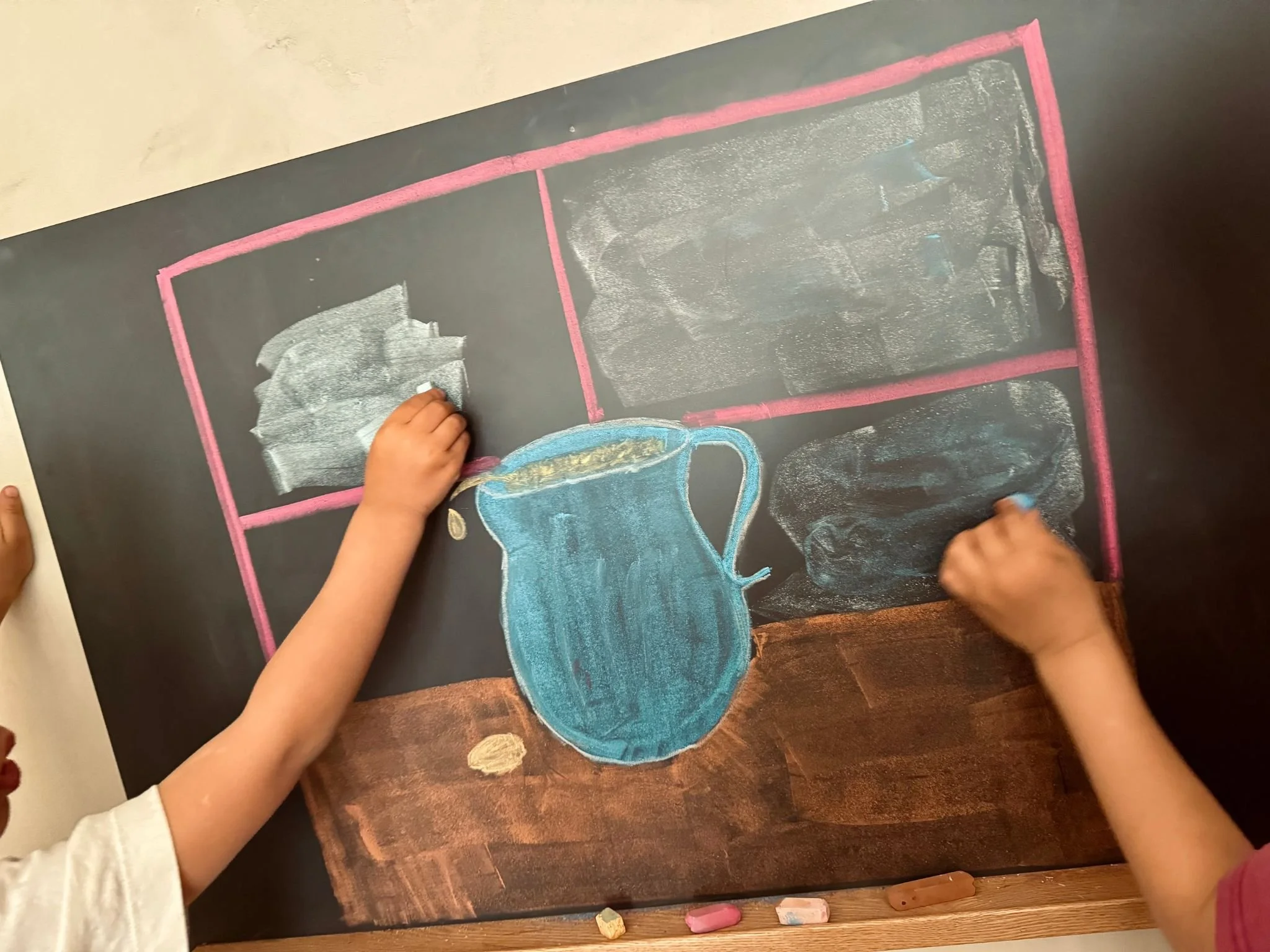
So what I did when we were learning our letters is I would often draw a picture on the chalkboard the night before, or sometimes my kids would help draw it too, and the picture would represent the new letter and the story that was being told for that day.
I particularly loved the Waldorf Alphabet book with it’s clever pictures and it was very inspiring for finding imagery for letters, along with Pinterest and so many blogs.
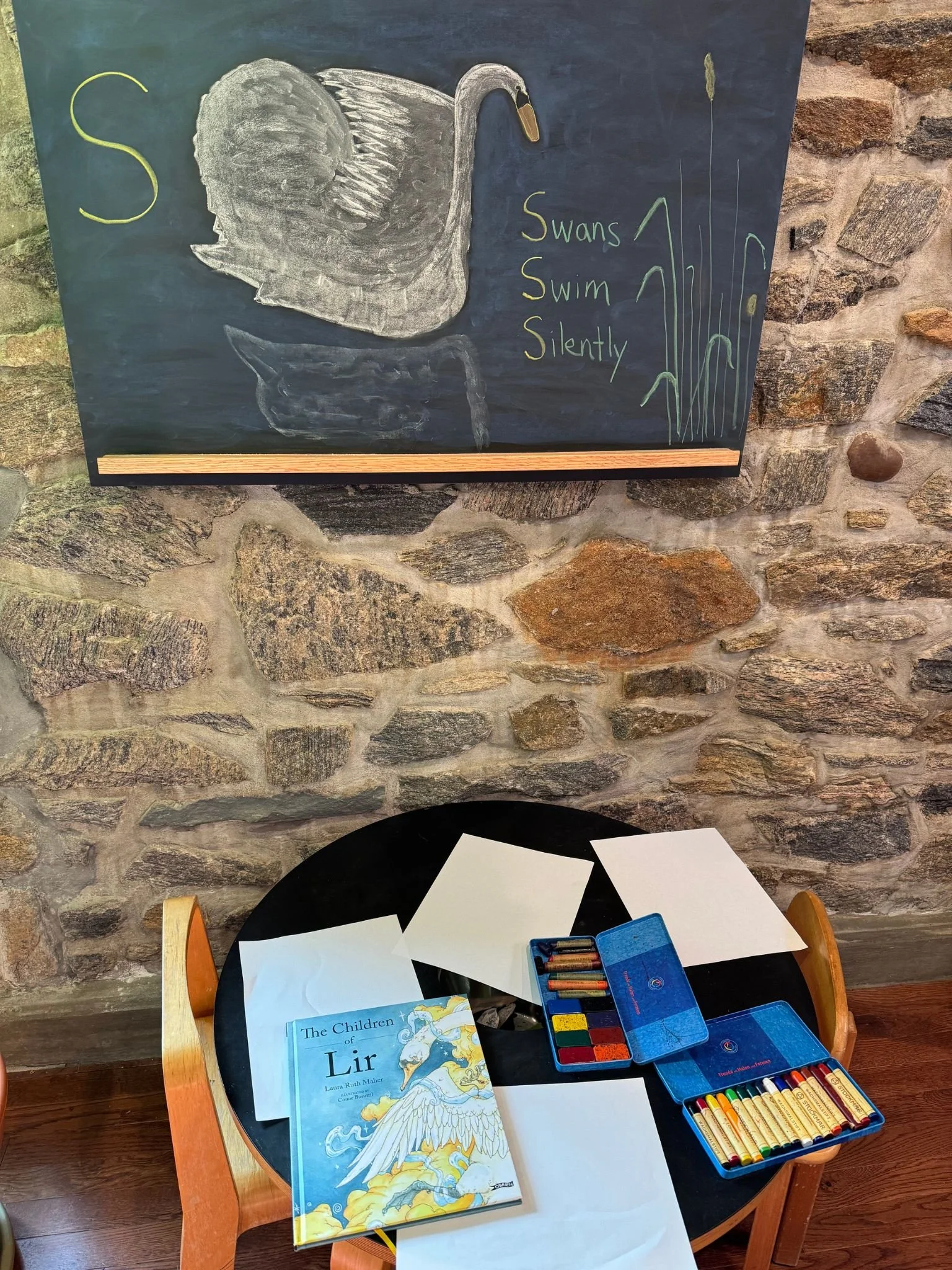
Here was the letter S for swan. I told the Irish legend, “The Children of Lir,” that is about four children that are turned into swans by their evil stepmother. It is a renowned legend in Irish mythology. You can even see that I tried to make the swan head and body into a S shape. This was often my goal to make the letter inside the actual picture. If you want an excellent telling of this story I highly recommend Tom Sweeney’s album “Irish Songs and Stories for Children.” The way he tells this story is an absolute delight.
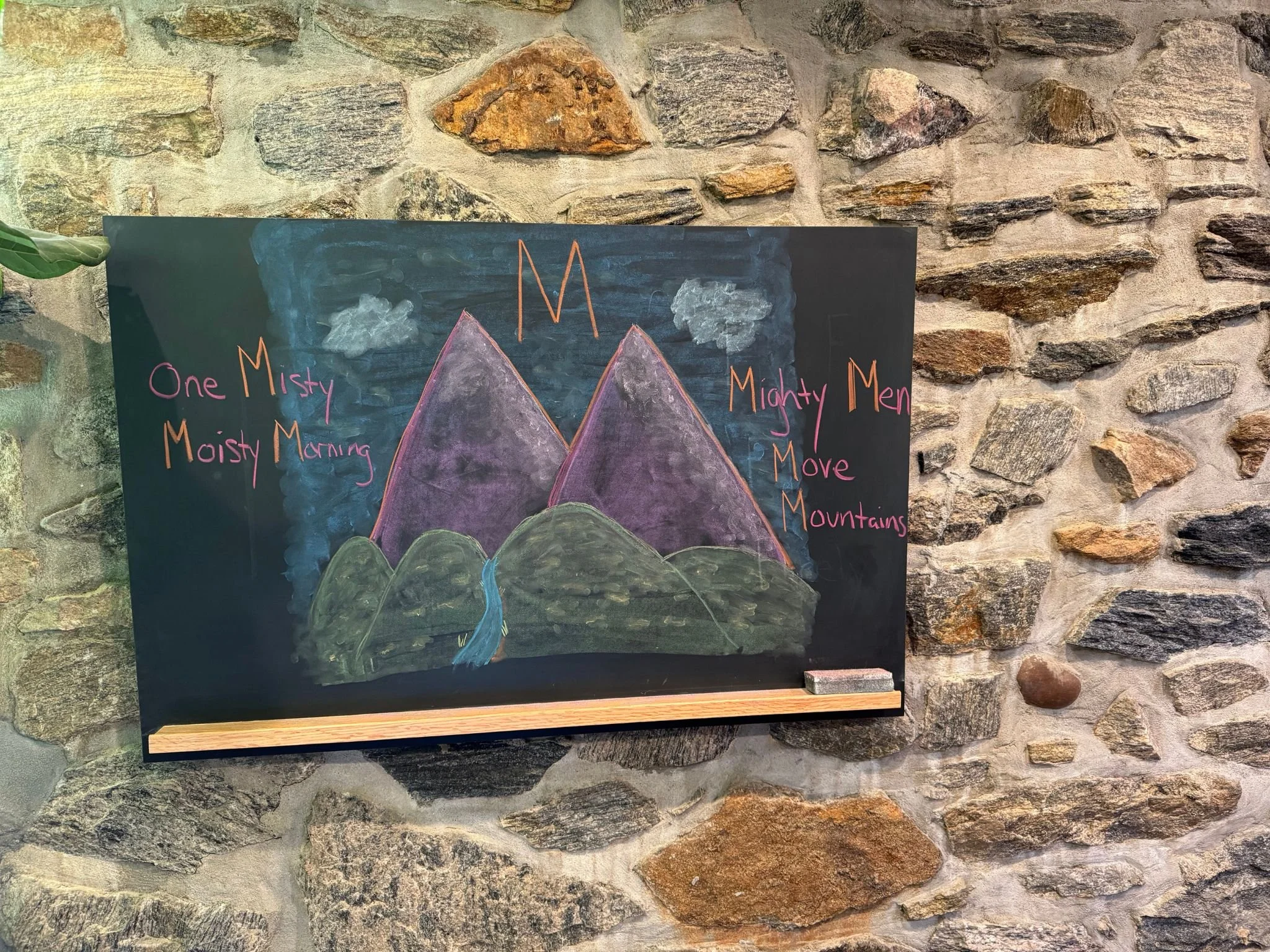
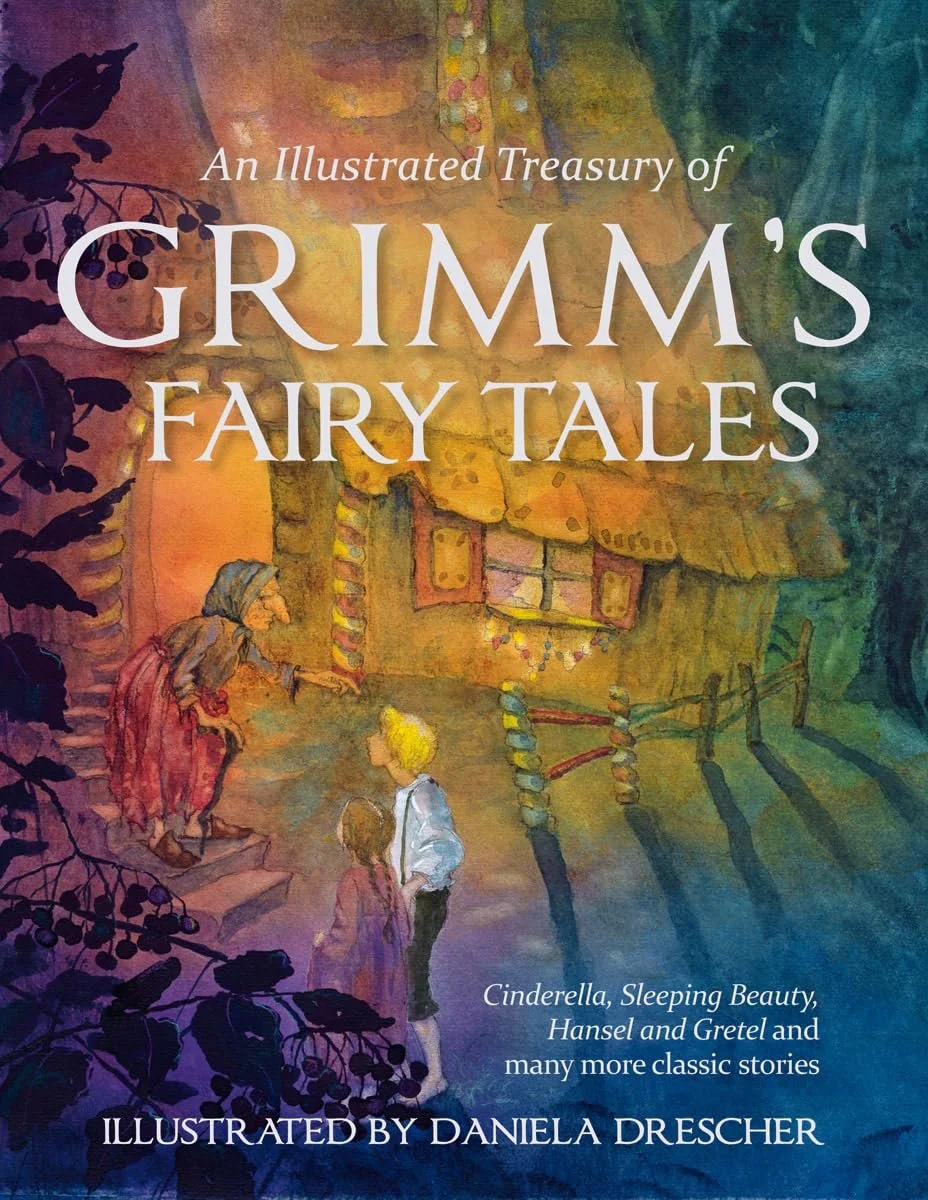
Here is letter M for mountain which was an easy one to accomplish this goal with making the picture be the letter. I told the Grimm story, “Simeli Mountain,” which is also one of my favorite Grimm’s fairytales.
Now I can say without a shadow of a doubt that my child LOVED learning the letters this way. He already loves stories and would probably be content listening to me tell stories and read books to him all day long. This philosophy approached learning the letters in such an imaginative, creative and embodied way. The child becomes intimately familiar with the letter, in not just a purely functional phonics sound way, but in a way that captures their imagination. And isn’t that what learning is all about?
Now of course, hand in hand with starting formal letters and writing and phonics sounds, music has been integrated into everything we do. It has not only made learning easier, but more joyful, fun and connected.
Just today I was listening to my son sing London Bridge Is Falling Down while he was rummaging in the kitchen for a snack, and it goes without saying that a huge part of our homeschooling has been music and will continue to be music. Because music is intrinsically linked to everything; to our deepest memories, our visceral feelings and emotions and to how we express ourselves authentically. To remove music from learning or life, seems counterintuitive and most especially with children who learn in a holistic manner unknowingly.
The beauty of homeschooling is that we have the freedom to make childhood as musical, creative and connected as we want. Playing clapping games, singing nursery rhymes, learning musical concepts have all been the key to making learning to read not only easy, but joyful. I’ll continue sharing more about how music has become deeply integrated into how we live life and learn. I will also share more about specific curriculum and texts we selected for certain subjects, but I will save that for its own post.

Books and Materials We Use and Love
This post contains affiliate links. If you purchase through them, I may receive a small commission - at no extra cost to you. Thank you for supporting my work!
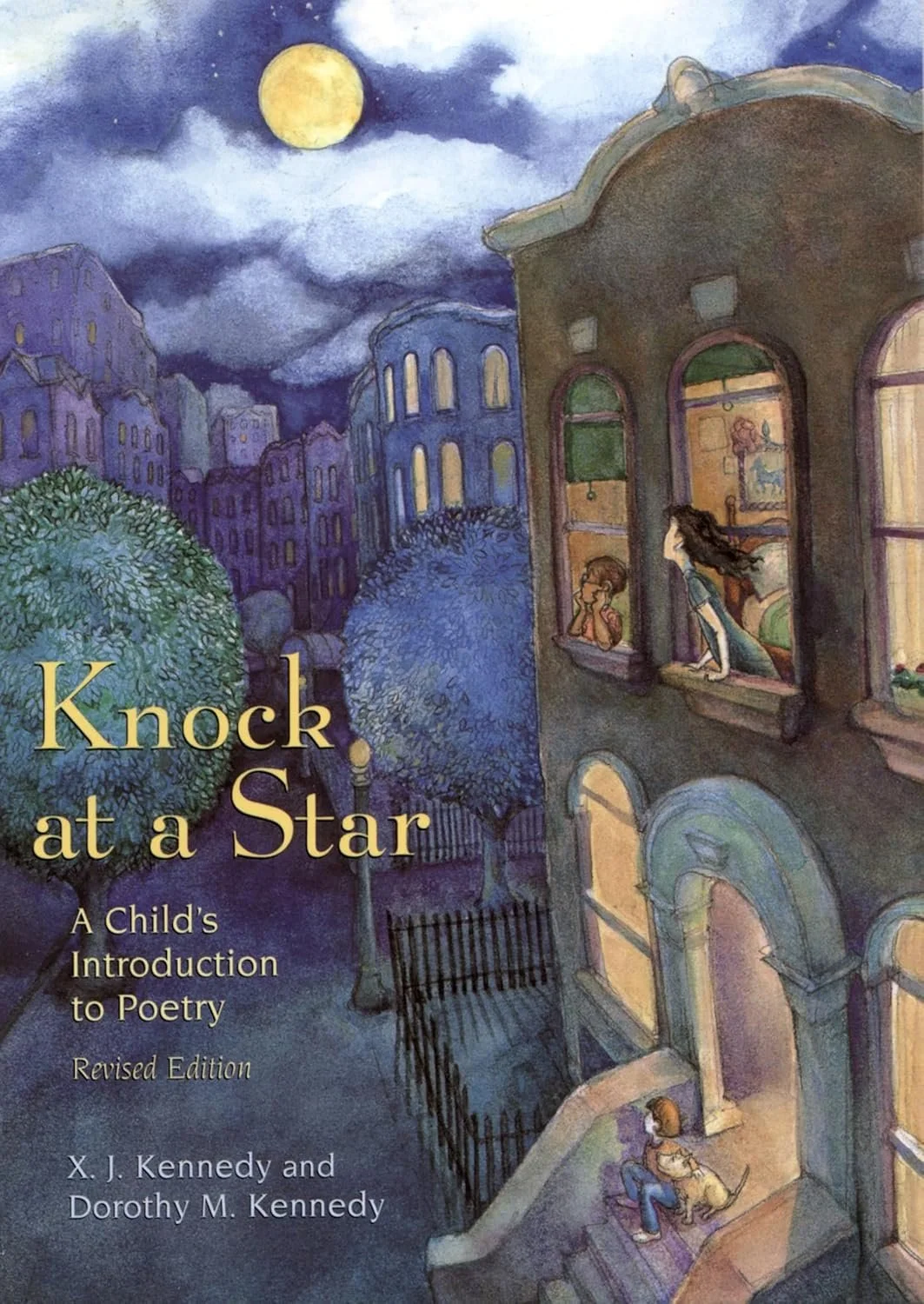
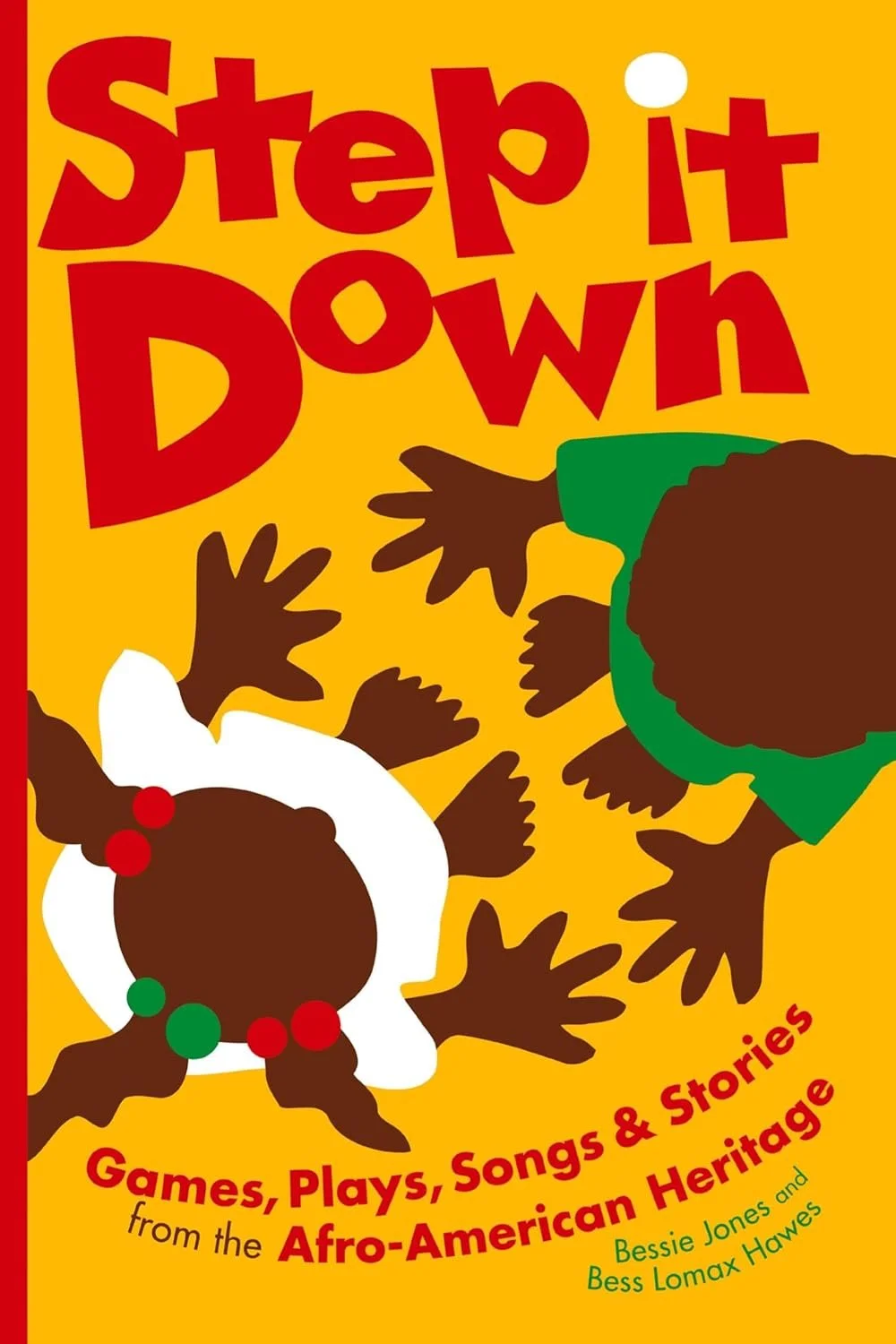
Since there are so many items we use and it would take so long to list them all here, I am going to upload the lists via Bookshop.org (which supports local bookstores in your community) and my Amazon storefront (not ideal I know, but at least helps send me income and support my work). You can peruse the lists and drop any questions you have in the comments below. I’ll be digging into a lot of these books and supplies in future blog posts, so stay tuned for more insights about a lot of these books individually, soon!
Bookshop.org Booklist
(Books)

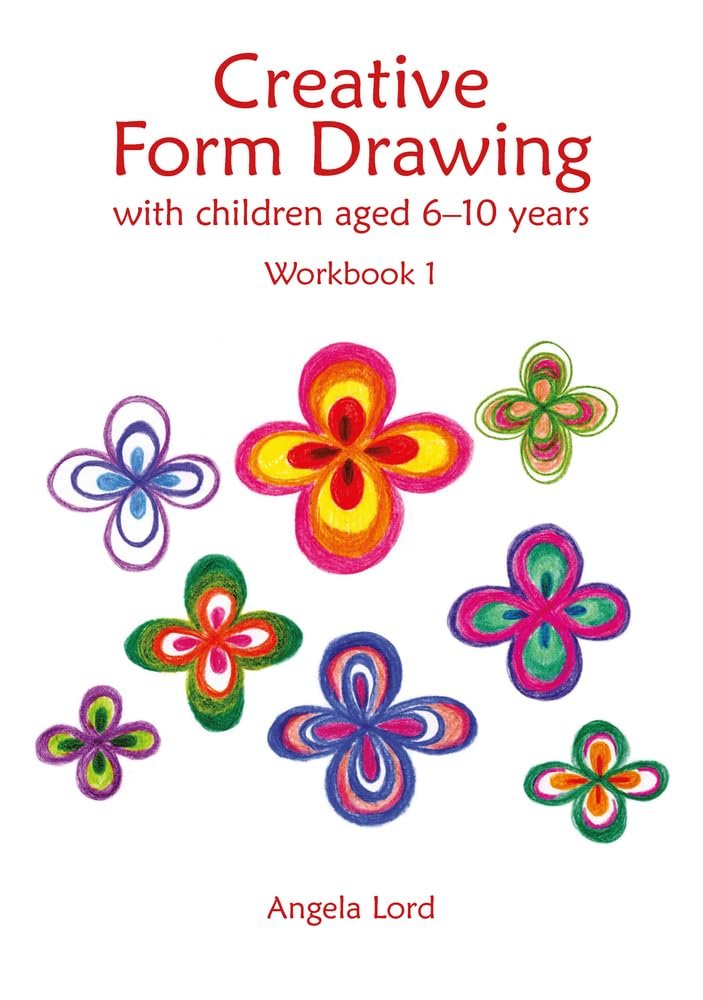
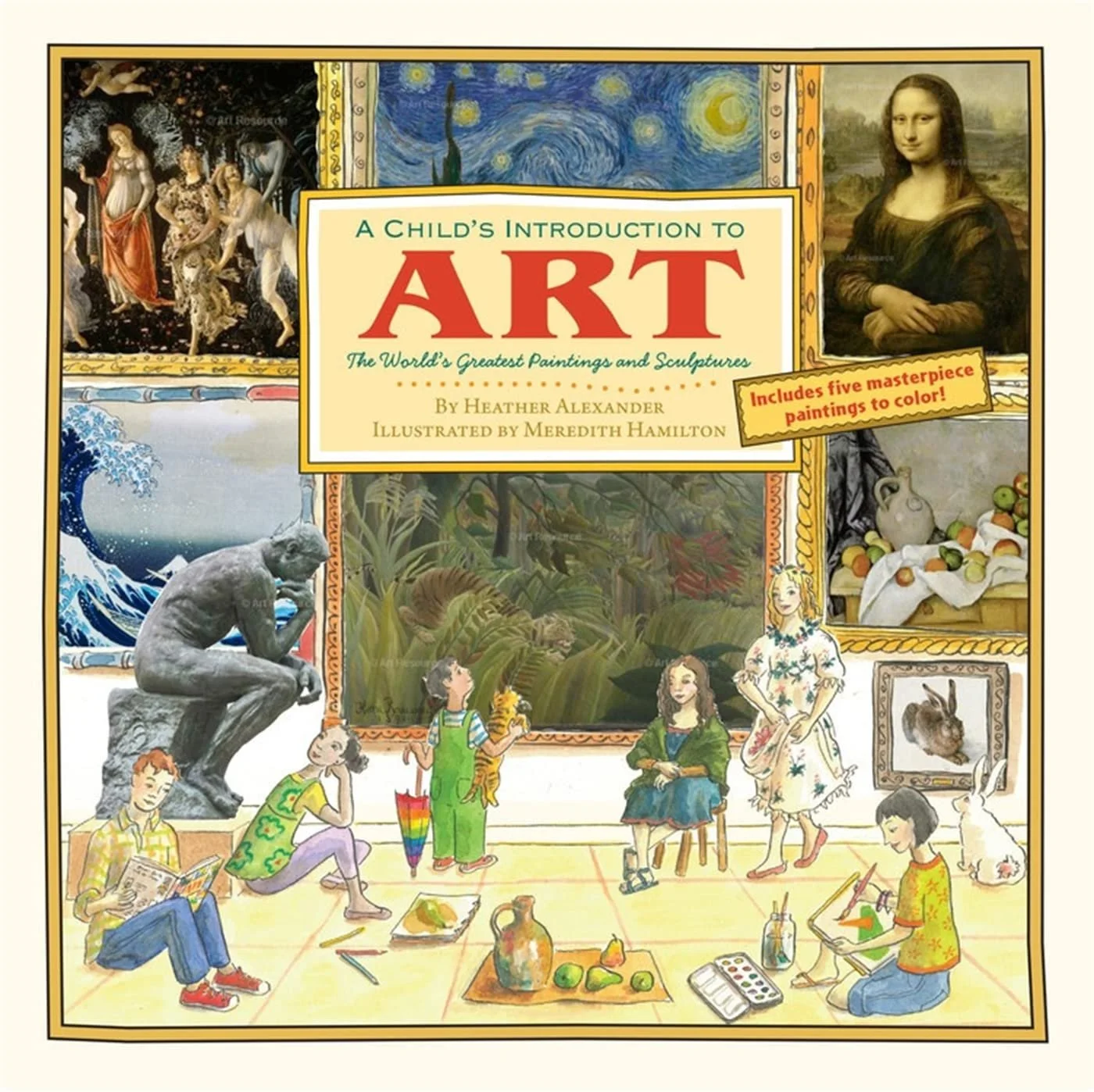
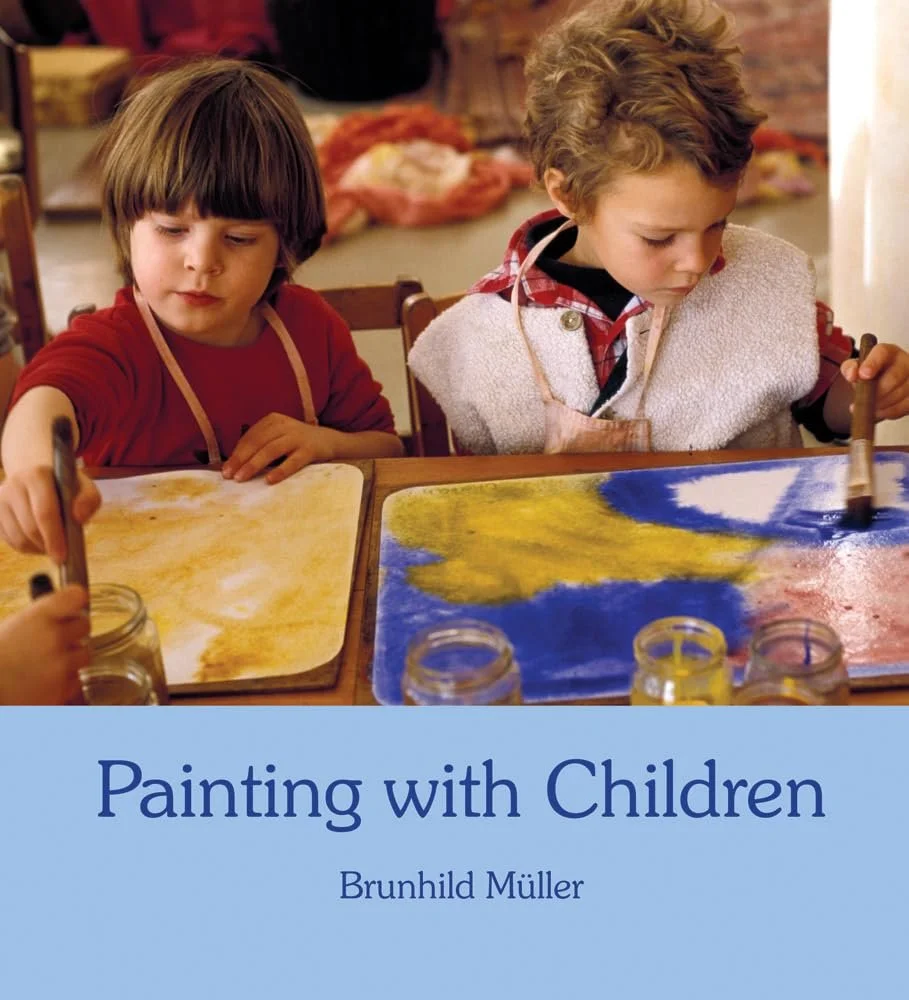
My Amazon Storefront
(Books + Supplies)
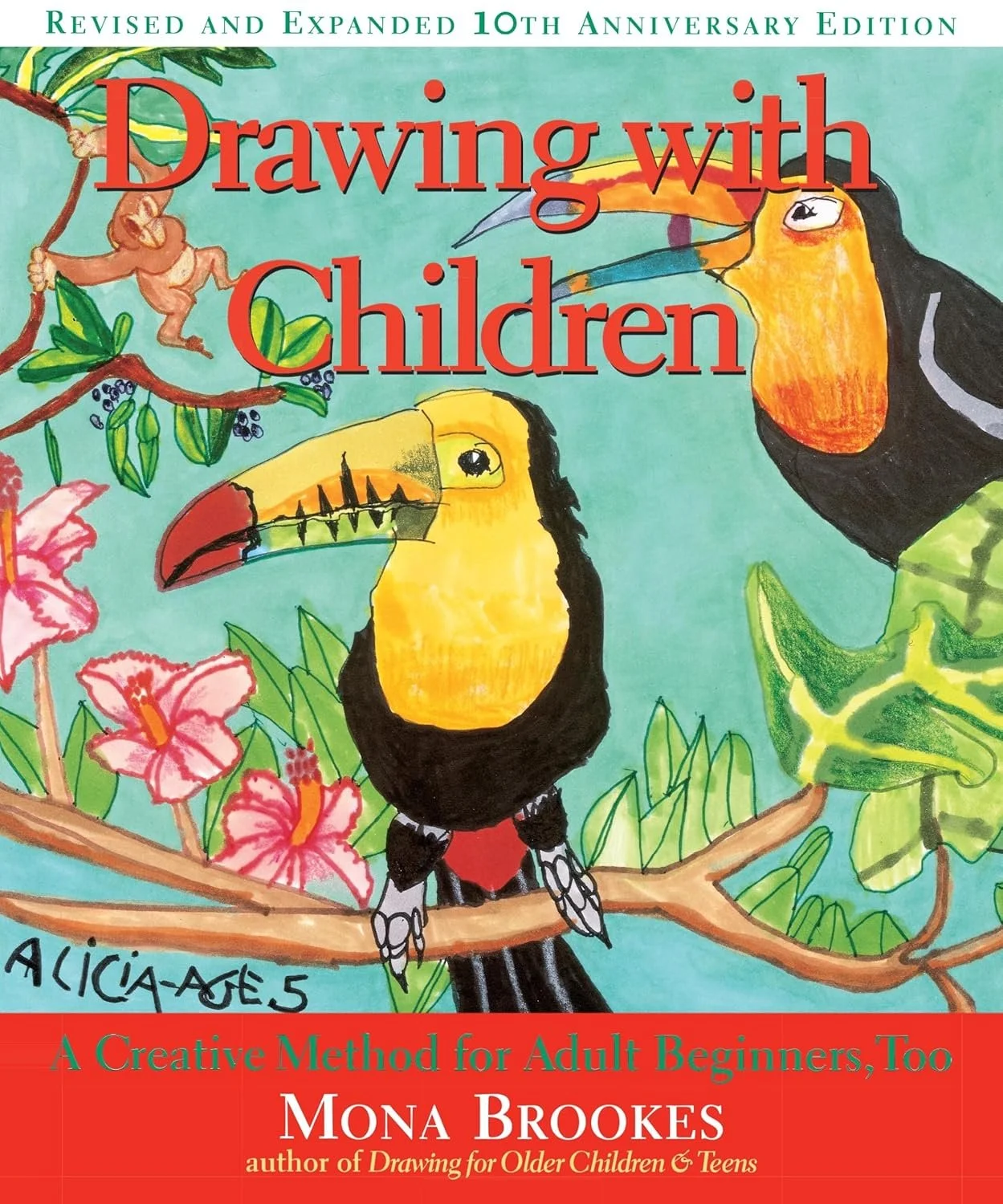
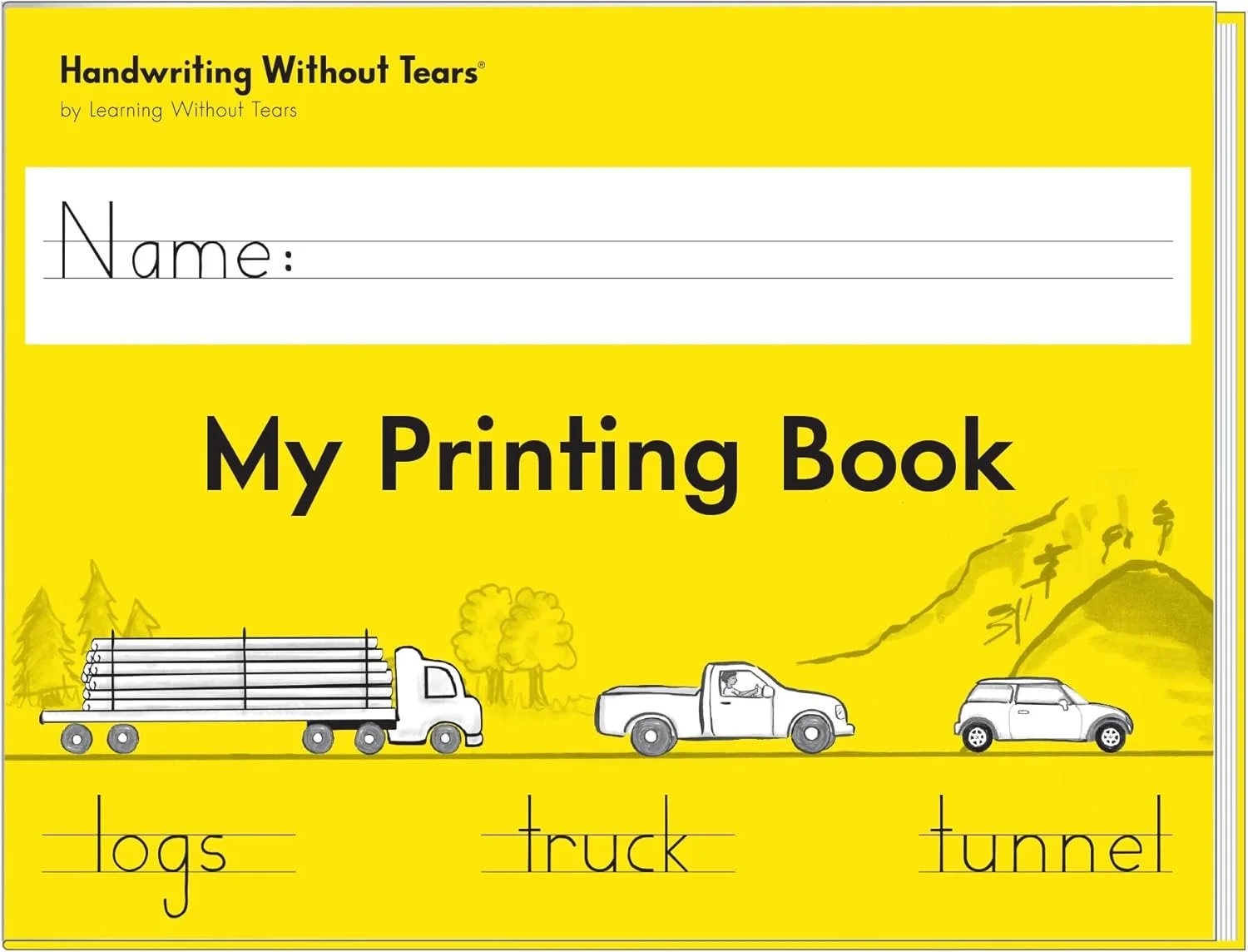
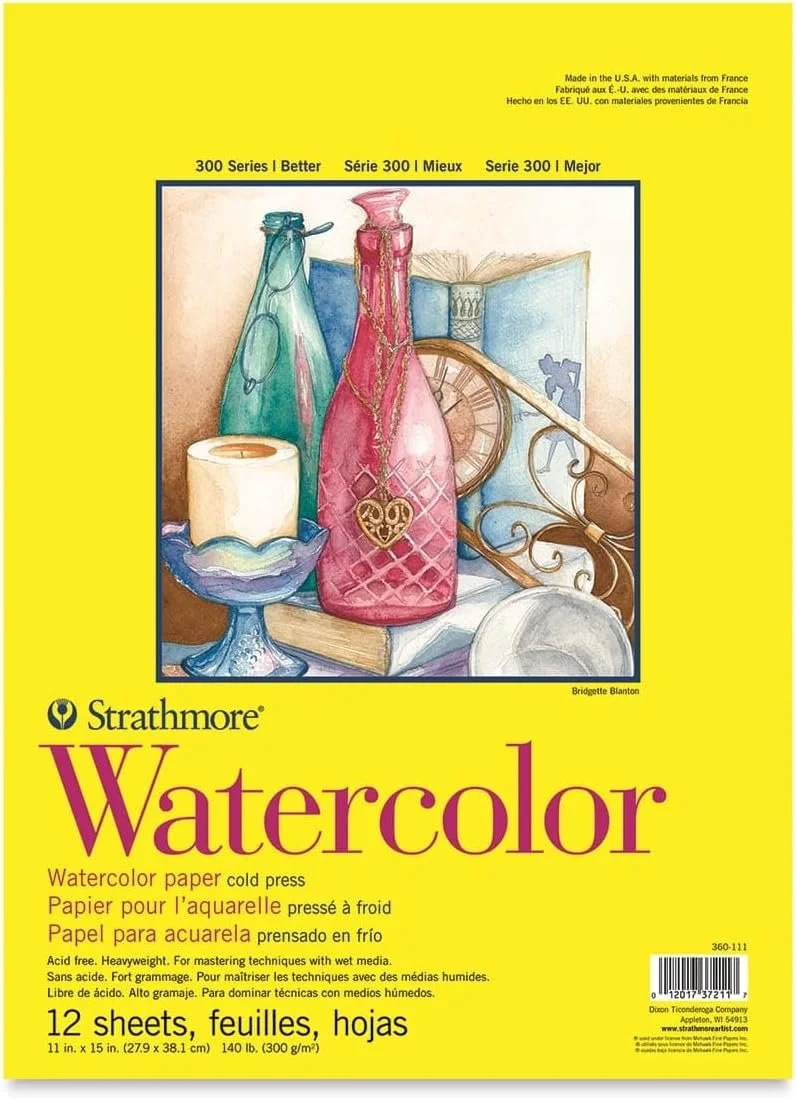
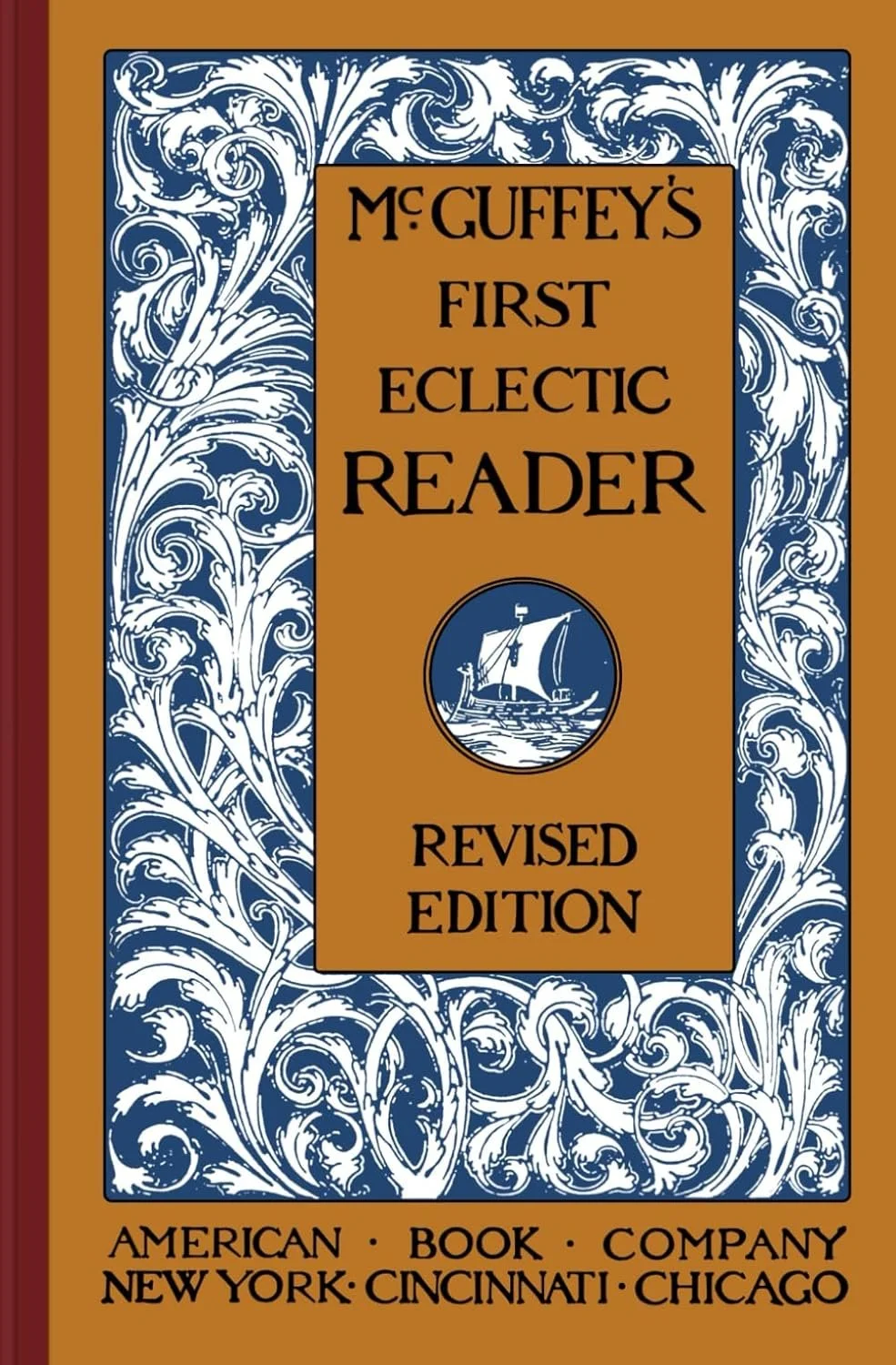
Music Supplies
(The Nestling Company, supporting a small mom owned shop in Maine.)
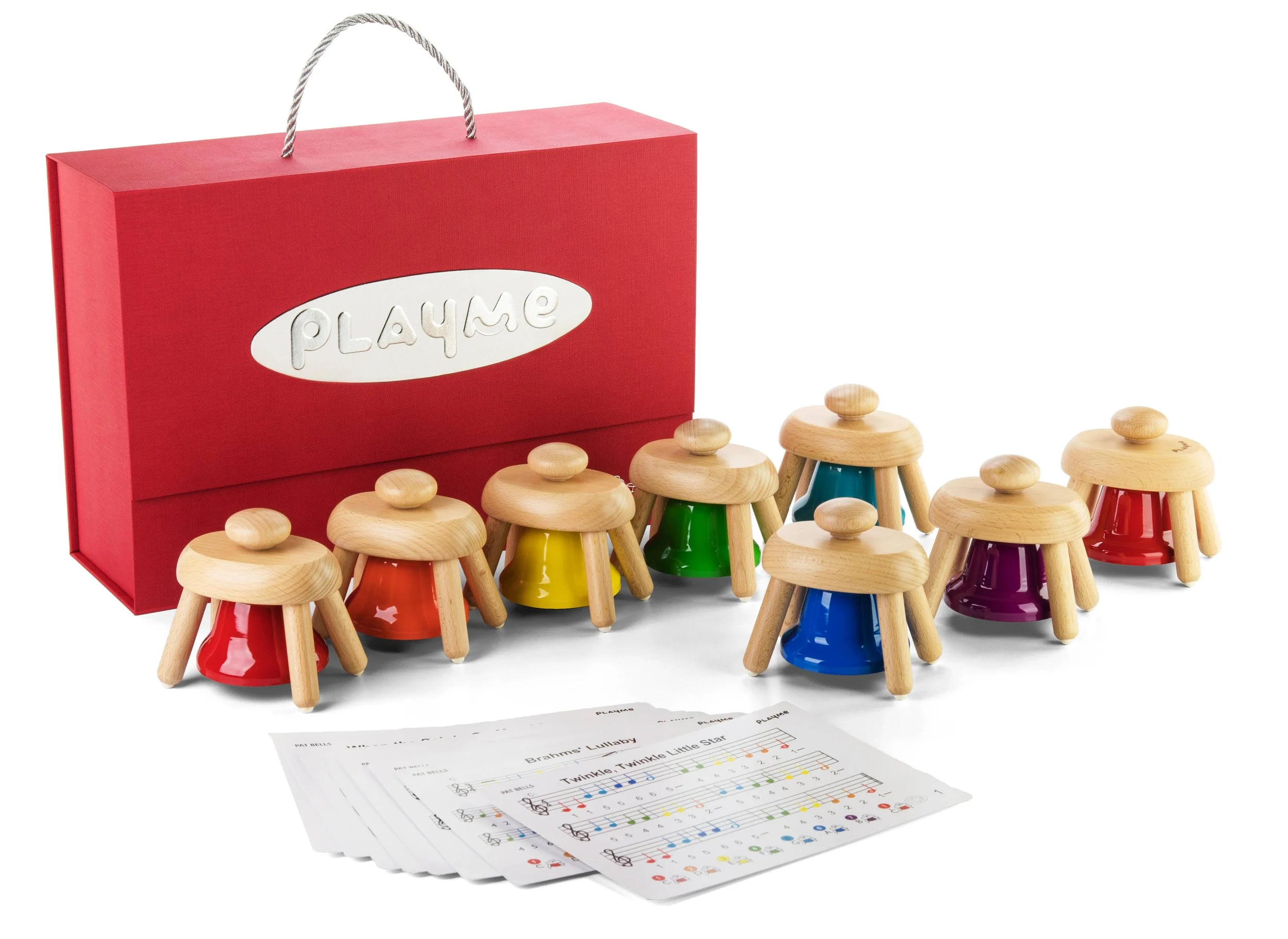
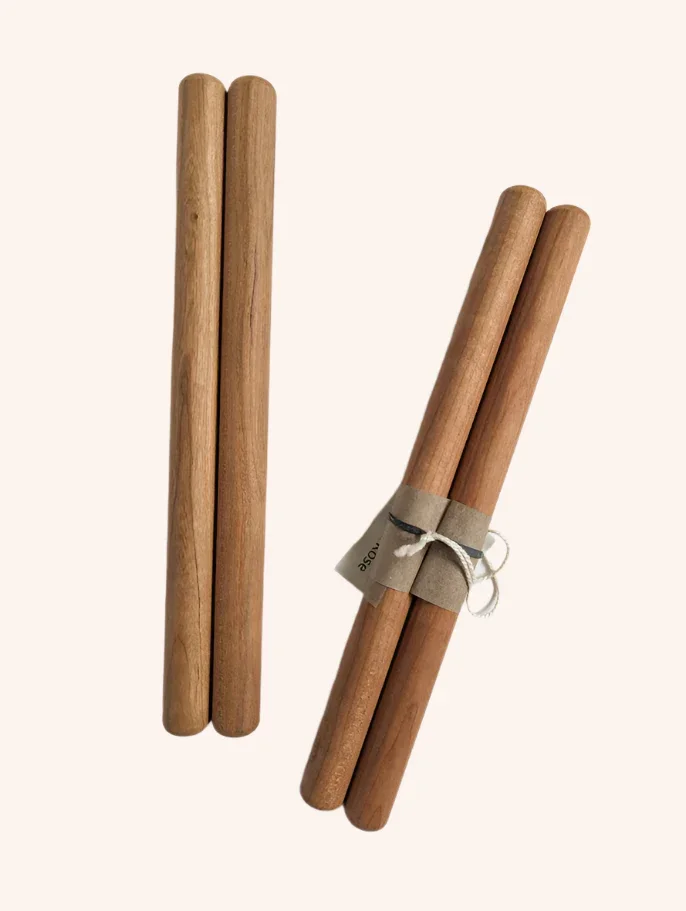
If I was to recommend two musical instruments to start learning with music it would be music bells and rhythm sticks. We use these almost every single day. So much musical learning can happen with these simple instruments and our voice of course! Click the photos to be sent directly to the item.
Use my links and code: magicalmusicmethod for $5.00 off the music bells, + free shipping in USA.
Bella Luna Toy Store
(Click each item for link.)
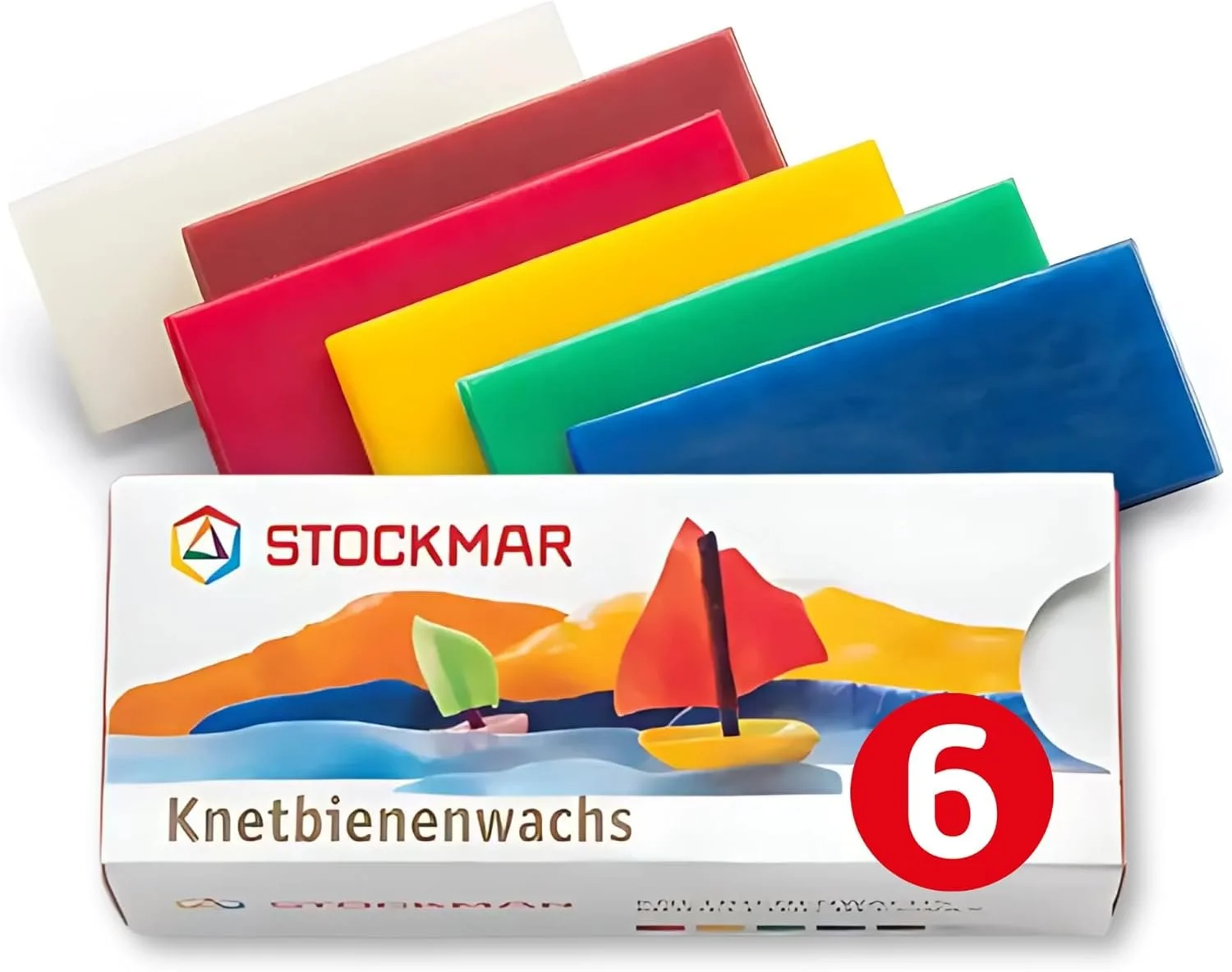
We warm the beeswax in our hands while listening to a story or singing and often shape things we are singing or learning about - flowers, animals, buildings, you name it!
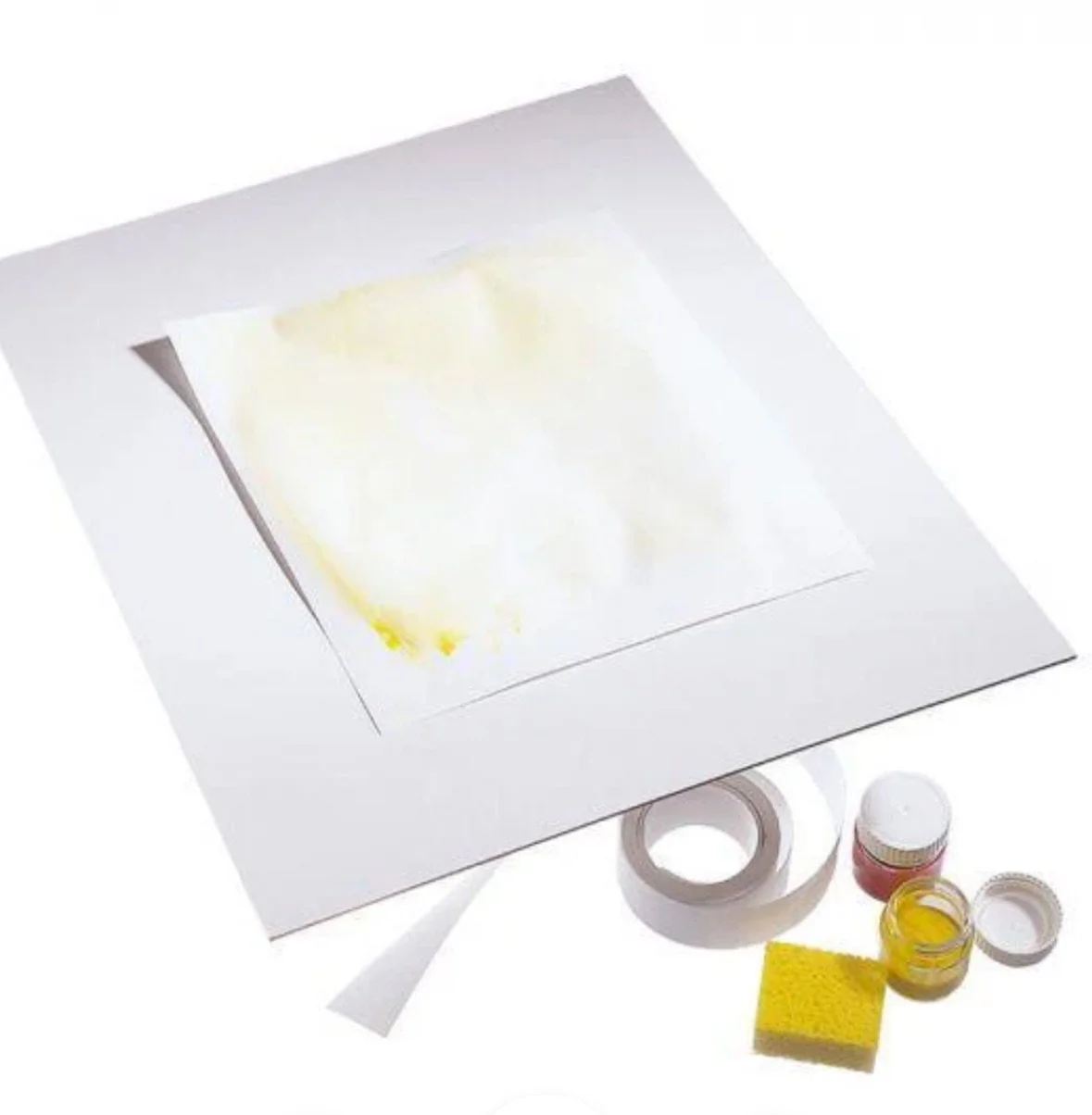
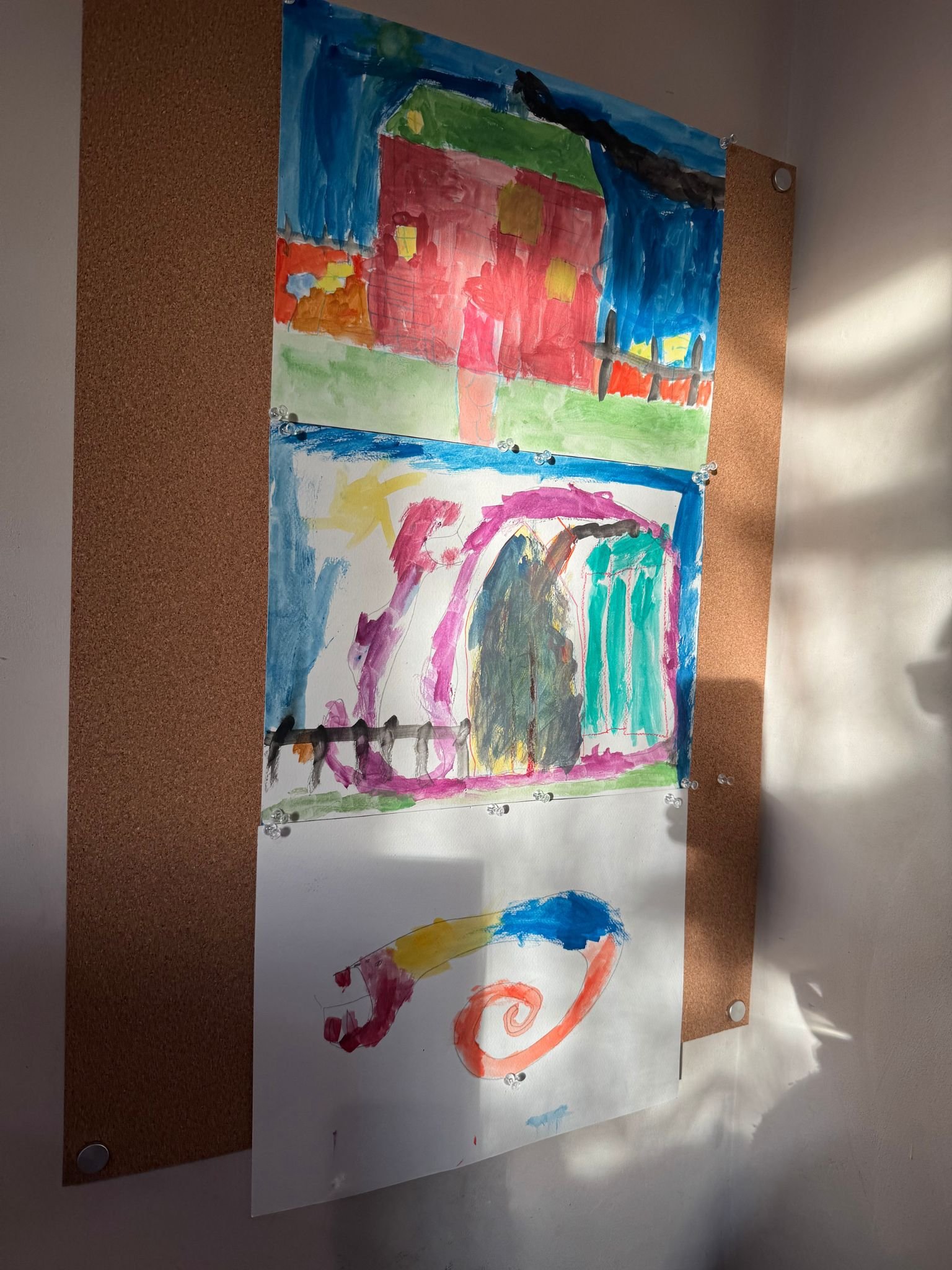
This board is light and easy to clean and saves our wood table from water and paint (for the most part) and is perfect for wet on wet watercolor painting. We often tape our work to the board with artist tape and it then creates a lovely framed edge around the art piece!
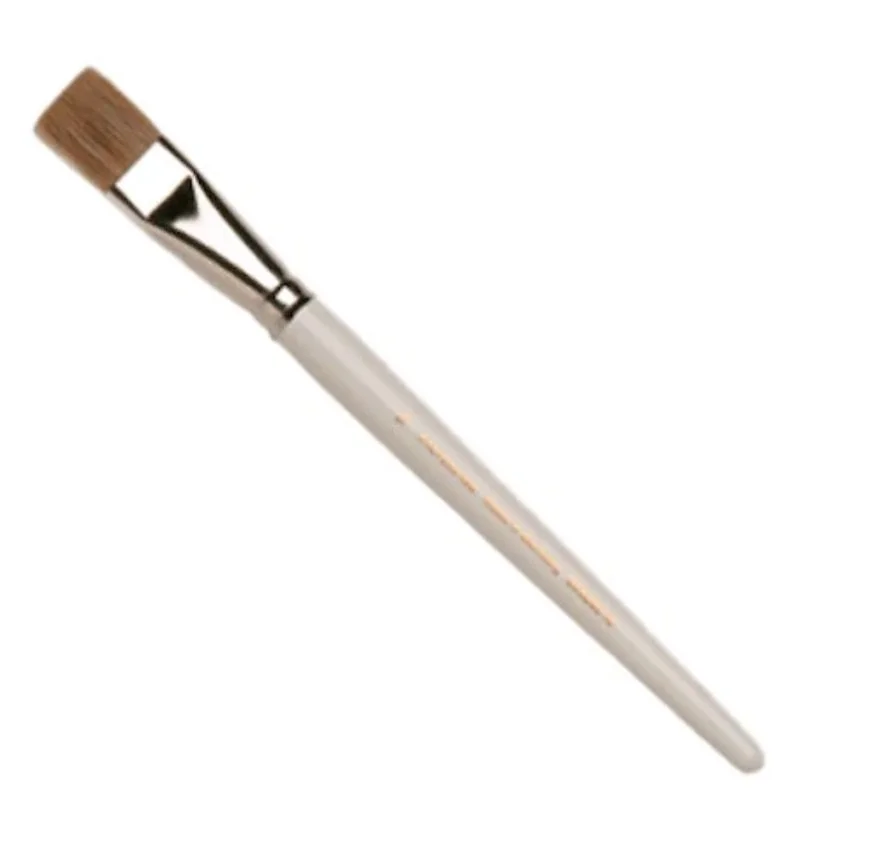
This brush is really superb. It doesn’t shed terribly like a lot of other paintbrushes and I think the size is perfect for small hands.
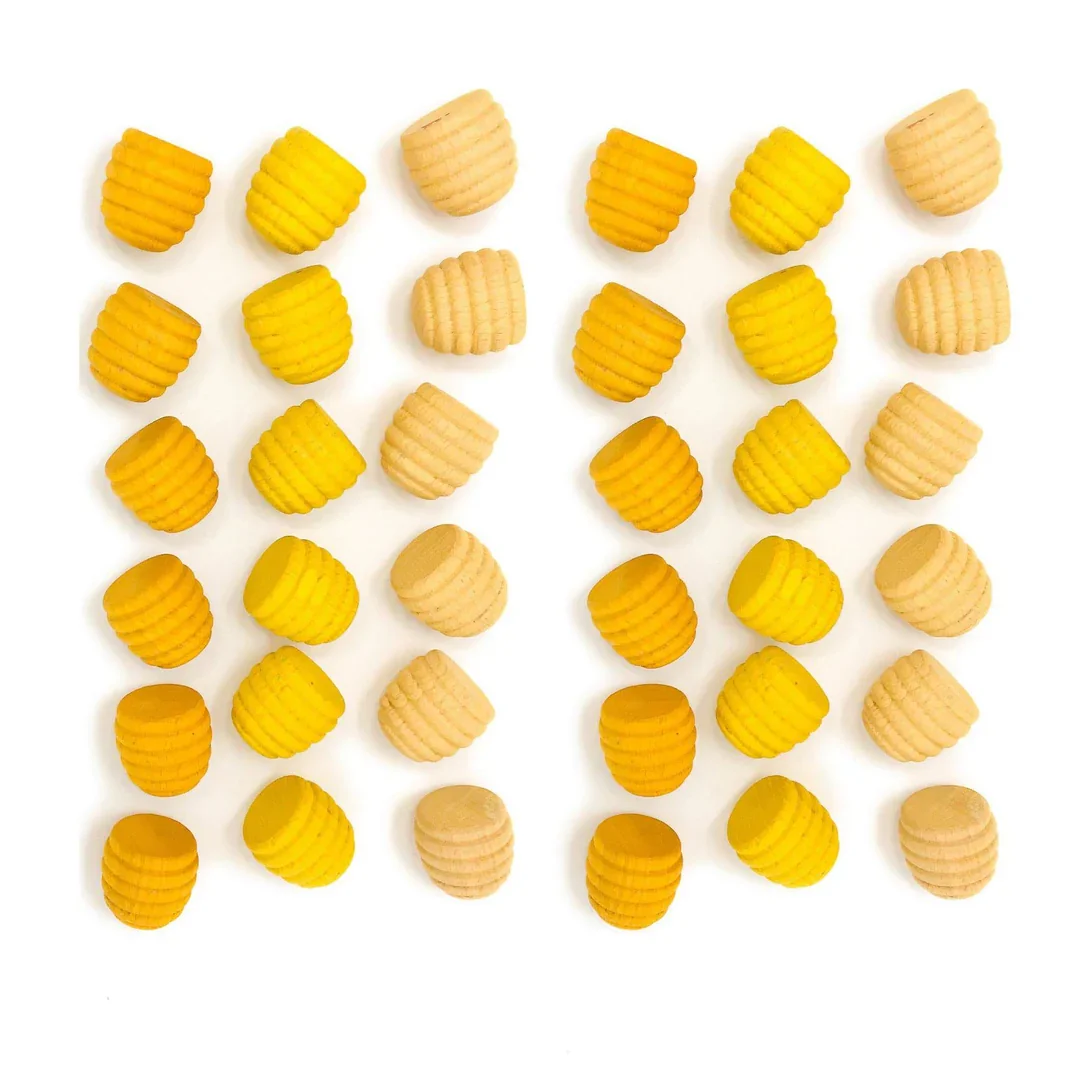
We have loved the Grapat set for math and have imagined lots of bees and honey with subtracting, adding, multiplying and dividing happening.
If you would like to see links to more resources and items I love, they can be found on the Links page of my website. I have lists of musical books, playlists, teaching knitting with song to children and favorite supplies and a link to my new YouTube channel where I will be delving into lots of topics, including homeschooling. Would love to see you over there as a subscriber. :)
Here is my latest video: